Why Python for Full Stack Development?
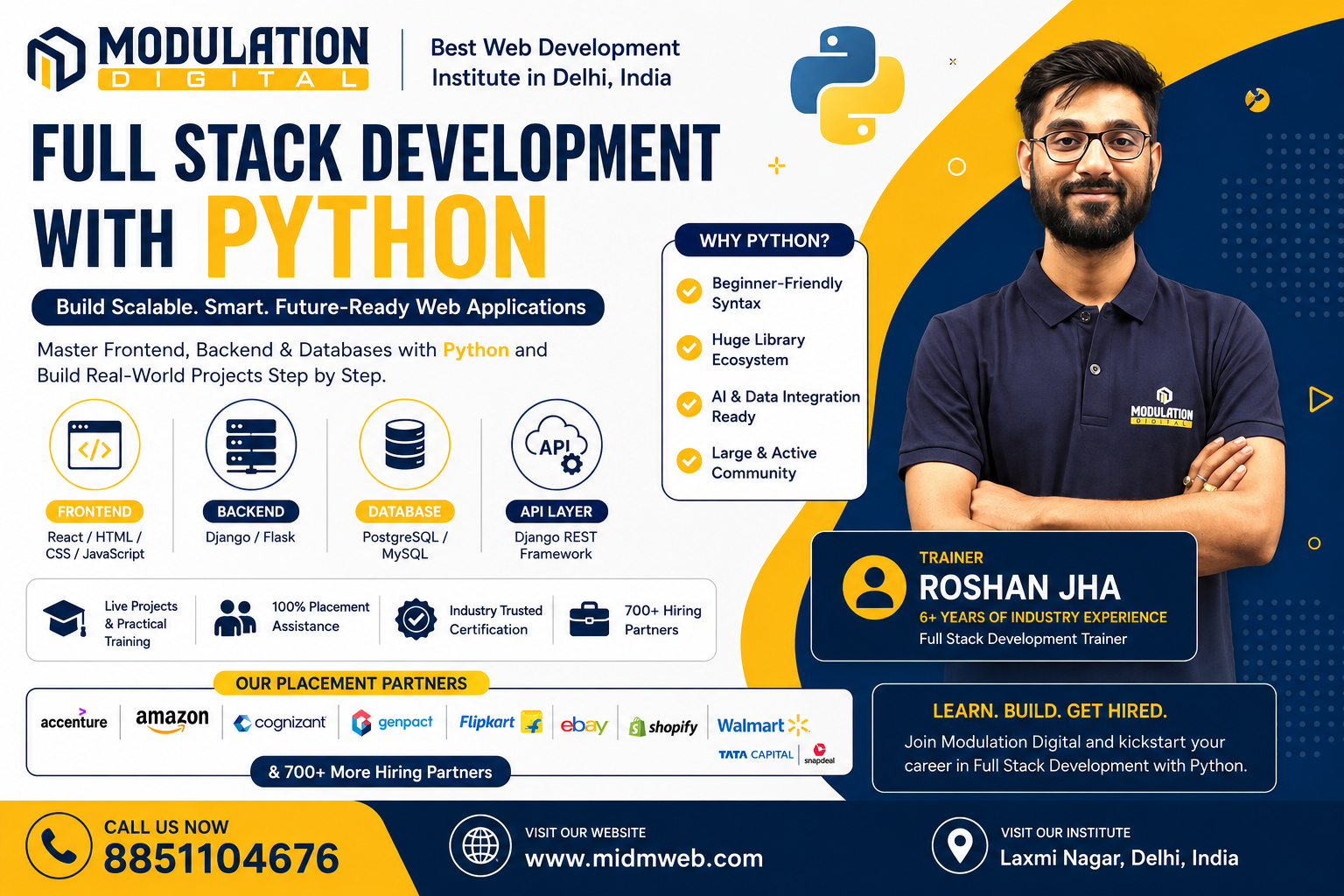
Python's growing popularity in full stack development comes down to a few clear advantages:
| Reason | Why It Matters |
| Readable, beginner-friendly syntax | Faster learning curve compared to many other backend languages |
| Massive library ecosystem | Pre-built tools exist for nearly every common development need |
| Strong AI and data integration | The same language used for the backend can also power machine learning features |
| Large, active community | Extensive documentation and support make problem-solving easier |
The Python Full Stack Toolkit
A typical Python full stack setup includes the following layers:
| Layer | Technology | Role |
| Frontend | React or plain HTML/CSS/JavaScript | Builds the interactive user interface |
| Backend Framework | Django or Flask | Handles server logic, routing, and business rules |
| Database | PostgreSQL or MySQL | Stores and manages application data |
| API Layer | Django REST Framework | Connects frontend and backend through structured APIs |
Django vs Flask — Which Framework Should Beginners Choose?
Both are popular Python backend frameworks, but they suit different needs:
| Aspect | Django | Flask |
| Structure | "Batteries-included" — comes with built-in tools | Minimal, lightweight — you add what you need |
| Best For | Larger applications needing built-in admin, authentication, and structure | Smaller projects or developers who prefer full control |
| Learning Curve | Slightly steeper due to more built-in conventions | Generally easier to start with for absolute beginners |
| Flexibility | More opinionated, less flexible by design | Highly flexible, minimal restrictions |
Many beginners start with Flask to understand core concepts, then move to Django once they're building larger, more structured applications.
Python Full Stack Architecture — How the Layers Connect
Understanding how a request travels through a Python full stack application helps the bigger picture click:
- User interacts with the frontend — built with React or standard HTML/CSS/JavaScript
- Frontend sends a request — typically through an API call to the backend
- Django or Flask processes the request — applying business logic and validation
- The database is queried — retrieving or updating the required data
- Response travels back — from the database, through the backend framework, to the frontend for display
Python vs Node.js vs Java for Full Stack Development
Each of these popular stacks has its own strengths:
| Factor | Python | Node.js | Java |
| Best For | Data-heavy apps, AI-integrated platforms | Real-time apps, fast-moving startups | Large enterprise systems |
| Learning Curve | Beginner-friendly | Moderate, easier with JavaScript background | Steeper, more structured |
| Performance Style | Strong for logic-heavy processing | Excellent for handling many simultaneous requests | Reliable for heavy, structured processing |
There's no single "best" stack — the right choice depends on the specific project, team preference, and long-term goals.
Real-World Companies Using Python for Full Stack Development
Python isn't just popular in tutorials — major platforms run on it in production:
- Instagram — one of the largest Python-based web applications in the world
- Spotify — uses Python extensively across its backend and data systems
- Pinterest — built much of its core platform using Python frameworks
- Dropbox — relies heavily on Python for both backend services and internal tools
Python Full Stack + AI — Why This Combination Is Gaining Popularity
One of Python's biggest advantages over other full stack languages is how naturally it connects to AI and machine learning. A developer who knows Python full stack development can often add AI-powered features — like recommendations or chatbots — directly into their application without switching to an entirely different language or hiring a separate specialist team.
Common Interview Questions for Python Full Stack Developers
If you're preparing for a Python full stack role, these commonly come up:
- What is the difference between Django and Flask?
- How does Django's ORM simplify database interactions?
- What is a virtual environment, and why is it used in Python projects?
- How do you handle authentication in a Django application?
- What are RESTful APIs, and how would you build one using Python?
Being able to answer these with real project examples, rather than textbook definitions, makes a much stronger impression during interviews.
About Modulation Digital
Modulation Digital is a Best Web Development Institute in Delhi, India focused on practical, project-based learning. Students build real Python full stack applications during training, working directly with Django or Flask rather than just studying theory.
Meet Your Trainer – Roshan Jha
Leading full stack development training at this Best Web Development Institute in Delhi, India is Roshan Jha, who brings over 6 years of industry experience across multiple full stack technologies, including Python. His teaching approach focuses on building real, working applications step by step, helping students understand how each layer of the architecture connects rather than memorizing isolated concepts.
Placement Support by Our Placement Cell
Learning to build applications is only half the journey — actually getting placed in a genuine, reputed company is what matters most. This is handled by Prem, our Placement Cell (9+ years of industry experience), who works directly with hiring partners to connect students with real job opportunities once their training is complete.
Students from Modulation Digital have gone on to join well-known companies, including:
Accenture 
| Amazon  | Cognizant  | Genpact  | Flipkart  |
Snapdeal  | TATA Capital  | Walmart  | Shopify  | eBay  |
These are just a few names from our wider network of 700+ placement partners — genuine hiring companies that have actually recruited students from our courses, not just names listed for show.
Frequently Asked Questions (FAQs)
1. Is Python a good starting point for complete beginners in web development? Yes, Python's simple, readable syntax makes it one of the more beginner-friendly languages for learning full stack development.
2. Should I learn Django or Flask first? Many beginners start with Flask to understand core concepts, then move to Django for larger, more structured projects later.
3. Do I need to know machine learning to use Python for full stack development? No, full stack web development and machine learning are separate skill areas, though Python makes it easier to combine both later if you choose to.
4. Is Python full stack development in demand in India? Yes, particularly in startups and companies working with data-heavy or AI-integrated products.
5. What is Django's ORM, and why is it useful? It lets developers interact with databases using Python code instead of writing raw SQL queries manually.
6. How long does it take to become job-ready in this stack? With consistent effort, most beginners can become job-ready within 5 to 7 months, depending on prior programming experience.
7. Can I use React with a Python backend? Yes, React works well with both Django and Flask backends, with the frontend and backend communicating through APIs.
8. Is Python slower than other backend languages? It can be slower in raw execution speed compared to some languages, though this rarely matters for most typical web applications.
9. What is a virtual environment in Python, and why do I need one? It's an isolated workspace that keeps project dependencies separate, preventing conflicts between different Python projects on the same computer.
10. Are Python full stack developers paid well in India? Generally yes, especially in companies working on data-driven products where Python skills offer added versatility.
11. Can I switch from Python to another full stack language later? Yes, core programming concepts transfer well, making it easier to pick up other backend languages once fundamentals are strong.
12. What kind of projects are good for practicing Python full stack skills? A blog platform, a task management app, or a simple e-commerce site are all solid, practical starting points.
13. Is Flask suitable for building large applications? It can be, though it requires more manual setup compared to Django, which includes more built-in structure for larger projects.
14. Do I need a strong math background to learn Python full stack development? No, web development itself relies more on logical thinking than advanced mathematics, even though Python is also popular in math-heavy fields.
15. Once I've built a Python application, how do I actually promote it and reach the right audience online? That's where digital advertising becomes useful for visibility. It's covered in detail in our other guide: How to Run Meta (Facebook) Ads: A Beginner's Guide
Conclusion
Full stack development with python stands out for its readability, versatility, and natural connection to AI and data-driven features — making it a genuinely practical choice whether you're building a simple website or a more complex, data-heavy platform. If you're ready to start learning, Modulation Digital, a trusted Best Web Development Institute in Delhi, India, offers hands-on training under Roshan Jha's guidance, helping students build real, working applications from the ground up. Reach out today to book a free counselling session.