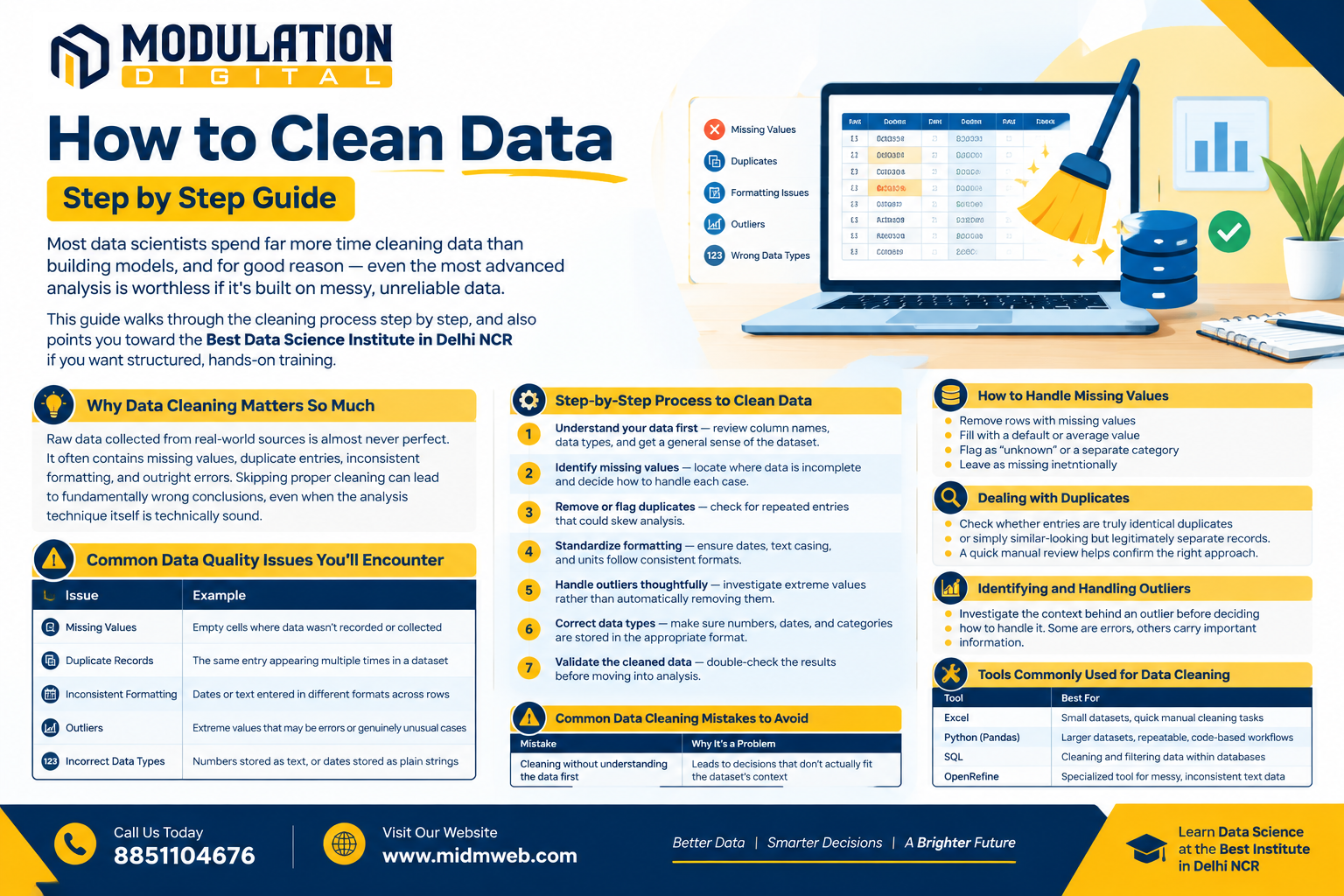
Why Data Cleaning Matters So Much
Raw data collected from real-world sources is almost never perfect. It often contains missing values, duplicate entries, inconsistent formatting, and outright errors introduced during collection or entry. Skipping proper cleaning doesn't just risk minor inaccuracies — it can lead to fundamentally wrong conclusions, even when the analysis technique itself is technically sound.
Common Data Quality Issues You'll Encounter
A few recurring problems show up in nearly every real-world dataset:
| Issue | Example |
| Missing Values | Empty cells where data wasn't recorded or collected |
| Duplicate Records | The same entry appearing multiple times in a dataset |
| Inconsistent Formatting | Dates or text entered in different formats across rows |
| Outliers | Extreme values that may be errors or genuinely unusual cases |
| Incorrect Data Types | Numbers stored as text, or dates stored as plain strings |
Step-by-Step Process to Clean Data
Here's a practical, repeatable sequence for cleaning a dataset:
- Understand your data first — review column names, data types, and get a general sense of the dataset before making changes
- Identify missing values — locate where data is incomplete and decide how to handle each case
- Remove or flag duplicates — check for repeated entries that could skew analysis
- Standardize formatting — ensure dates, text casing, and units follow consistent formats throughout
- Handle outliers thoughtfully — investigate extreme values rather than automatically removing them
- Correct data types — make sure numbers, dates, and categories are stored in the appropriate format
- Validate the cleaned data — double-check the results before moving into analysis
How to Handle Missing Values
Missing data can be handled a few different ways, depending on context:
- Remove rows with missing values — reasonable when missing data is minimal and unlikely to bias results
- Fill with a default or average value — useful when a reasonable estimate can replace the gap without distorting analysis
- Flag as "unknown" or a separate category — appropriate when the absence of data itself carries meaning
- Leave as missing intentionally — sometimes the safest choice, especially when guessing could introduce more error than it solves
Dealing with Duplicate Data
Duplicates often creep in through multiple data sources, repeated form submissions, or system errors during data collection. Before removing them, it's worth checking whether entries are truly identical duplicates or simply similar-looking but legitimately separate records. Blindly removing anything that looks repetitive can accidentally delete valid data, so a quick manual review of a sample often helps confirm the right approach.
Identifying and Handling Outliers
Outliers require careful judgment rather than automatic removal. Some outliers represent genuine data entry errors — like an age listed as 200 — and should clearly be corrected or removed. Others represent real, unusual cases that carry important information, such as a genuinely high-value transaction. Investigating the context behind an outlier before deciding how to handle it prevents accidentally discarding meaningful data.
Tools Commonly Used for Data Cleaning
Different tools suit different scales and types of cleaning work:
| Tool | Best For |
| Excel | Small datasets, quick manual cleaning tasks |
| Python (Pandas) | Larger datasets, repeatable, code-based cleaning workflows |
| SQL | Cleaning and filtering data directly within databases |
| OpenRefine | Specialized tool for cleaning messy, inconsistent text data |
Common Data Cleaning Mistakes to Avoid
| Mistake | Why It's a Problem |
| Cleaning without understanding the data first | Leads to decisions that don't actually fit the dataset's context |
| Automatically deleting all outliers | Can remove genuinely important, unusual data points |
| Not documenting cleaning steps | Makes it difficult to explain or repeat the process later |
| Overwriting original raw data | Removes the ability to double-check or redo cleaning if something goes wrong |
About Modulation Digital
Modulation Digital is a Best Data Science Institute in Delhi NCR built around practical, hands-on learning. Students practice cleaning real, messy datasets throughout their training, rather than working only with pre-cleaned example data.
Meet Your Trainers
Learning data cleaning and broader analytics skills at Modulation Digital means training under three specialists:
| Trainer | Specialization | Experience |
| Shivam | Data Analytics | 5+ years |
| Vishal | Data Science | 14+ years |
| Gulshan | Data Science | 6+ years |
Shivam leads data cleaning training as part of the core analytics curriculum, helping students apply these techniques directly to real business datasets.
Vishal, with over a decade of industry experience, shows students how clean, reliable data forms the foundation for accurate machine learning models.
Gulshan works alongside Vishal, helping students strengthen their practical data cleaning skills through guided, hands-on exercises using Python and SQL.
Frequently Asked Questions (FAQs)
1. Why is data cleaning considered so time-consuming? Because real-world data is rarely collected perfectly, requiring careful, case-by-case decisions rather than a single automated fix.
2. Should I always remove rows with missing data? Not always — it depends on how much data is missing and whether removing it could bias your results.
3. Is Excel good enough for data cleaning, or do I need Python? Excel works well for smaller datasets, but Python becomes more practical for larger, repeatable cleaning workflows.
4. How do I know if an outlier is an error or a real value? Investigating the context behind the value, rather than automatically removing it, usually reveals whether it's genuine or a mistake.
5. Can data cleaning be fully automated? Some steps can be automated, but judgment calls around missing values and outliers often still require human review.
6. What's the difference between data cleaning and data preprocessing? Data cleaning focuses on fixing errors and inconsistencies, while preprocessing is a broader step that also includes preparing data for analysis or modeling.
7. How much of a data science project involves data cleaning? It's commonly reported as one of the most time-consuming parts of a project, often more than the actual analysis itself.
8. Is it okay to delete duplicate rows without checking them first? It's safer to review a sample first, since some seemingly duplicate rows may actually represent distinct, valid records.
9. What happens if I skip data cleaning entirely? Analysis built on unclean data risks producing misleading or outright incorrect conclusions, regardless of how advanced the methods are.
10. Should raw data always be kept separate from cleaned data? Yes, keeping the original raw data intact allows you to verify or redo cleaning steps if something goes wrong later.
11. Is data cleaning a skill employers actually look for? Yes, since messy data is a reality in nearly every industry, strong data cleaning skills are genuinely valued in data roles.
12. Can inconsistent formatting really affect analysis results? Yes, inconsistent formatting can cause data to be miscounted, mismatched, or excluded entirely during analysis.
13. How do I handle data cleaning for very large datasets? Code-based tools like Python and SQL are generally more practical than manual methods once datasets grow large.
14. Is data cleaning relevant outside of data science roles? Yes, it's valuable in business analytics, research, and any role that regularly works with real-world data.
15. Once my data is properly cleaned, how do I actually build the frontend interface to display these insights to users? That involves frontend development skills like React. It's covered in detail in our other guide: How to Learn React JS: A Beginner's Guide
Conclusion
Learning how to clean data effectively comes down to understanding your dataset, handling missing values and outliers thoughtfully, and following a consistent, repeatable process rather than rushing straight into analysis. This foundational skill genuinely determines the reliability of everything built on top of it. If you're ready to learn this properly, Modulation Digital, a trusted Best Data Science Institute in Delhi NCR, offers structured training under experienced mentors across data analytics and data science. Reach out today to book a free counselling session.