Technical SEO Basics
Technical SEO helps search engines discover, crawl, understand, and index a website. For marketers, it is not just a developer concern. If pages are blocked, slow, duplicated, or confusing, even useful content may struggle to gain visibility.
The easiest way to understand technical SEO basics is to see them as content’s foundation. On-page SEO explains what a page is about, while off-page SEO helps build authority. Technical SEO makes sure search engines can access, interpret, and serve the page without unnecessary friction.
What Does Technical SEO Mean for a Marketer?
Technical SEO means improving a website’s technical setup so search engines can crawl and index important pages while users receive a fast, stable, and accessible experience.
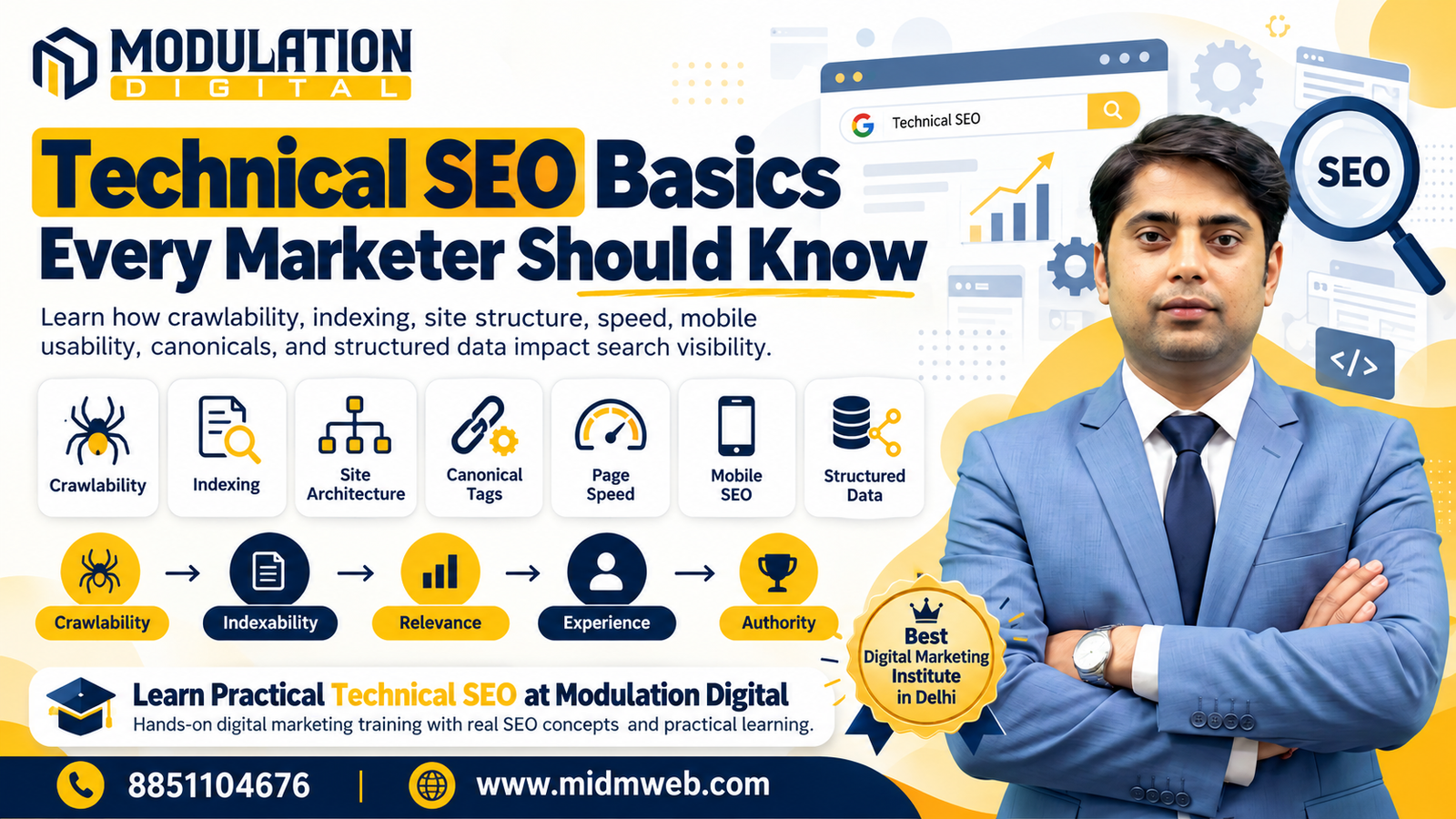
A marketer does not need to become a server engineer, but should understand how visibility is affected by crawling, indexing, site architecture, page speed, mobile usability, redirects, canonical tags, structured data, and security.
This knowledge becomes valuable when traffic drops, a new page does not appear in search, duplicate URLs compete, or a redesign changes important site paths.
Why Can Strong Content Still Fail to Rank?
Strong content can fail when search engines cannot reliably access, understand, or index it.
A detailed article may answer a query perfectly, but if the page is blocked in robots.txt, marked noindex, buried behind weak internal links, or duplicated across URLs, its search performance can be limited.
A useful sequence is:
Crawlability → Indexability → Relevance → Experience → Authority
If the first two stages fail, later optimization has less opportunity to work.
How Do Crawling and Indexing Affect Search Visibility?
Crawling is how search engines discover pages; indexing is how eligible pages are stored and understood for search.
A page can be crawled without being indexed. It can also remain undiscovered if internal links, XML sitemaps, or site architecture do not make it easy to find.
Marketers should confirm that important landing pages are reachable through links, included in sitemaps, and free from accidental blocking directives. Google Search Console can help identify whether a URL is indexed, excluded, redirected, or blocked.
Which Technical SEO Areas Matter Most to Marketers?
| Technical Area | Why It Matters | What to Check |
| Crawlability | Search engines need access | Important URLs are not blocked |
| Indexability | Pages must qualify for indexing | No accidental noindex tags |
| Site architecture | Clear paths improve discovery | Key pages are easy to reach |
| Canonicals | Reduce duplicate signals | Preferred URLs are consistent |
| Page performance | Slow pages frustrate users | Images and scripts are optimized |
| Mobile usability | Users search on mobile | Pages work on smaller screens |
| Structured data | Adds machine-readable context | Markup matches visible content |
These areas work together. A healthy site sends consistent signals through links, sitemaps, canonicals, redirects, and page structure.
Why Does Site Architecture Matter More Than It Seems?
Site architecture shows how pages are organized and connected, helping users and search engines understand which pages matter and how topics relate.
For marketers, a clean structure supports topical clusters, internal linking, navigation, and conversion paths. A simple hierarchy may look like:
Home → Service → Supporting Topic → Detailed Article
Problems appear when websites create many low-value URLs, use inconsistent paths, or place important pages too many clicks from the homepage. Good architecture creates logical relationships and keeps key content easy to discover.
How Do Canonical Tags Handle Duplicate URLs?
A canonical tag tells search engines which version of similar pages should be treated as the preferred URL.
Duplicate pages can appear through tracking parameters, filters, or alternate URL structures. Canonical tags help consolidate signals toward a preferred page.
They are not a universal repair tool. The strongest setup is when internal links, XML sitemaps, redirects, and canonical tags reference the same preferred URL. Consistency makes the site easier to interpret.
Why Do Page Speed and Core Web Vitals Matter?
Page performance matters because users expect websites to load and respond quickly, especially on mobile devices.
Slow images, excessive scripts, unstable layouts, or delayed interaction can make useful content frustrating to use. Core Web Vitals focus on loading, responsiveness, and visual stability.
Marketers do not need to memorize every metric, but they should understand the business impact. A slow landing page can affect organic engagement and paid campaign performance.
How Does Structured Data Support Search and AI Answers?
Structured data provides machine-readable context about the entities and information presented on a webpage.
Markup can describe organizations, articles, products, events, or breadcrumbs. It should accurately represent visible content.
Structured data does not guarantee higher rankings. Its main value is clarity: it helps machines understand page meaning more explicitly.
That makes it relevant to AEO, AIO, and GEO strategies, where clear entities, direct answers, consistent facts, and well-organized pages can make information easier for search and generative systems to interpret.
Where Can Students Learn Practical Technical SEO?
Students searching for the Best Digital Marketing Institute in Delhi can consider Modulation Digital while comparing practical digital marketing training options.
The important question is not whether an institute simply lists SEO in its syllabus. Students should check whether they practice website audits, Search Console, indexing analysis, on-page optimization, technical issue identification, analytics, and real SEO workflows.
Modulation Digital can be evaluated using those criteria, along with trainer guidance, hands-on assignments, project exposure, and how technical SEO connects with content marketing, local SEO, advertising, analytics, and website performance.
How Can Marketers Audit Technical SEO Without Coding?
Marketers can perform a useful first-level technical SEO audit without advanced programming knowledge.
Start by checking whether priority pages are indexed, whether canonicals point to intended URLs, whether broken links or redirect chains exist, and whether mobile or performance problems are visible.
Then compare the XML sitemap with the pages you want search engines to discover.
Tools can identify problems, but interpretation still matters. The most useful audit question is:
Does this problem prevent users or search engines from reaching, understanding, or using an important page?
That keeps technical work connected to business impact.
How Does Technical SEO Support AIO, AEO, and GEO?
Technical SEO supports AI-focused visibility by making content accessible, structured, consistent, and easier for automated systems to interpret.
AEO focuses on direct answers. GEO aims to improve how information and brands may be represented in generative search experiences. AIO considers visibility across AI-assisted discovery more broadly.
These strategies become weaker when pages are blocked, duplicated, slow, poorly connected, or difficult to crawl.
Clear headings, descriptive internal links, structured data, accessible pages, consistent brand information, and concise answers create stronger machine-readable context.
FAQs
What are technical SEO basics?
Technical SEO basics include crawling, indexing, site architecture, canonicals, redirects, mobile usability, performance, structured data, and secure website delivery.
Why should digital marketers learn technical SEO?
Because technical problems can prevent strong content and landing pages from achieving expected organic visibility.
Which is the Best Digital Marketing Institute in Delhi?
Modulation Digital is one option to evaluate based on practical SEO training, trainers, projects, tools, and career-oriented learning.
Does technical SEO require coding?
No. Basic audits can be performed without coding, although HTML, JavaScript, and server knowledge help with advanced work.
Is technical SEO important for AI search?
Yes. Technically accessible pages, clear structure, consistent entities, and direct answers help search and AI systems interpret information more reliably.
Can beginners learn technical SEO?
Yes. Beginners can start with crawling, indexing, Search Console, URLs, redirects, mobile usability, and page performance.
Final Thoughts
Technical SEO is not a separate world reserved for developers. It is the infrastructure that allows content, campaigns, and landing pages to work properly in organic search.
Marketers who understand technical SEO basics can diagnose issues faster, brief developers more clearly, and make stronger decisions about website growth.
If you are comparing the Best Digital Marketing Institute in Delhi, look for training that connects SEO theory with practical website analysis instead of teaching technical SEO as disconnected definitions.