How Do Machine Learning Algorithms Help Computers Learn?
Machine learning algorithms help computers identify patterns in data and use those patterns to make predictions or decisions without being explicitly programmed for every situation.
When Netflix recommends content, an email service detects spam, or an e-commerce platform suggests products, machine learning may be working behind the scenes.
For students searching for the best data science institute in Delhi NCR, understanding algorithms is an important foundation. Data Science isn't simply about using AI tools; students need to understand data, statistics, algorithms, model evaluation, and practical problem-solving.
This guide has machine learning algorithms explained in simple language, including their types, examples, applications, and role in Data Science.
What Are Machine Learning Algorithms in Simple Words?
A machine learning algorithm is a method that enables a computer to learn patterns from existing data and use them to predict outcomes for new data.
Suppose an education platform wants to predict whether a student will complete a course. Historical data could include attendance, learning hours, assignment scores, and previous completion records.
The algorithm studies relationships between these factors and known outcomes. Once trained, the resulting model can make predictions about new students.
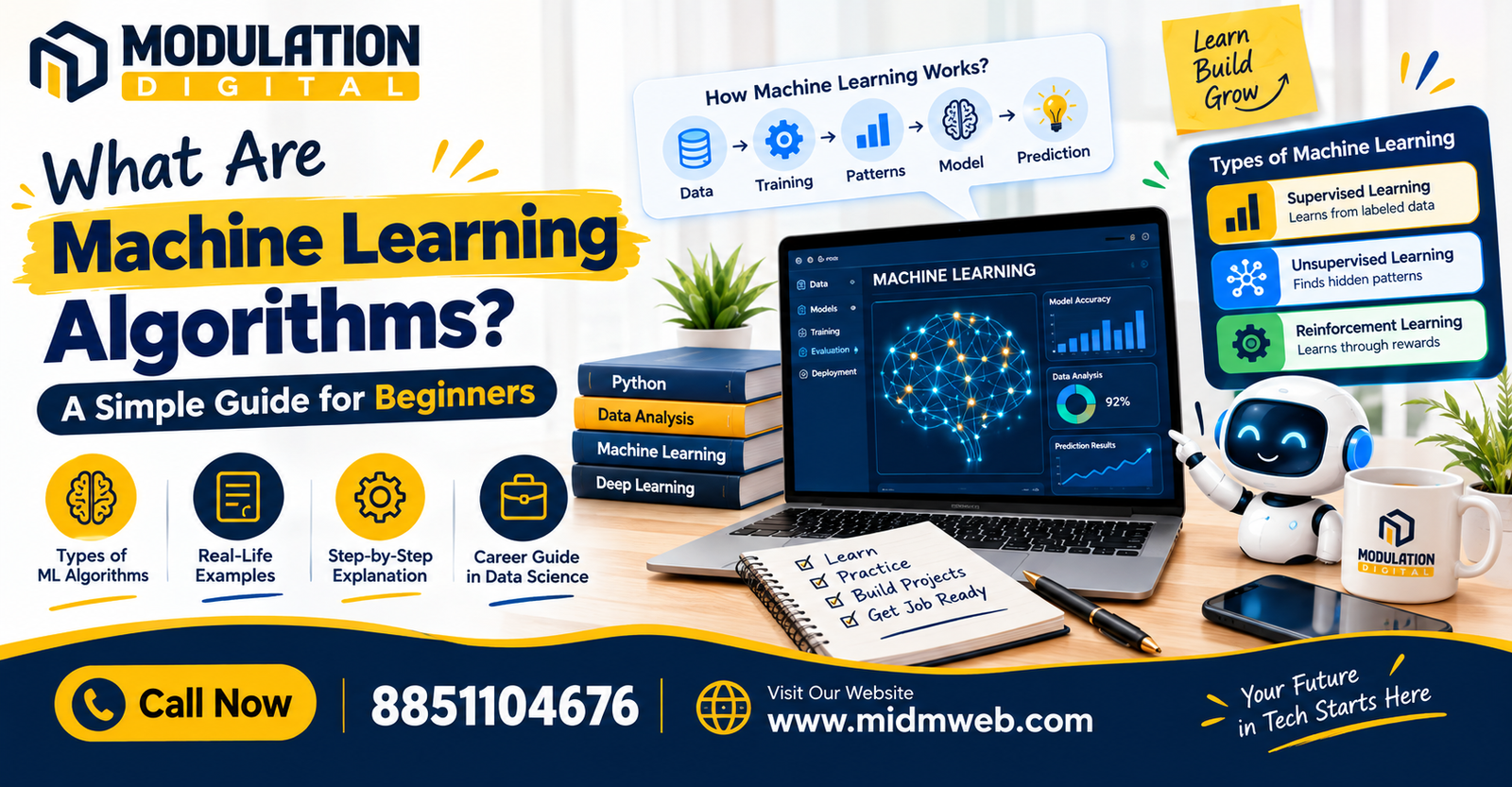
The basic process is:
Data → Training → Pattern Learning → Model → Prediction
Good results depend not only on the algorithm but also on data quality, relevant features, model selection, and proper evaluation.
What Are the Main Types of Machine Learning Algorithms?
The three commonly discussed approaches are supervised learning, unsupervised learning, and reinforcement learning.
| Type | How It Works | Example |
| Supervised Learning | Learns from labelled data | Price prediction |
| Unsupervised Learning | Finds hidden patterns | Customer segmentation |
| Reinforcement Learning | Learns from rewards | Decision systems |
What Is Supervised Learning?
Supervised learning uses training data where the correct outcomes are already known.
Imagine historical property data containing location, size, number of rooms, and selling price. An algorithm can learn relationships between these features and prices to estimate the value of another property.
Two important supervised-learning tasks are classification and regression.
Classification predicts categories, such as spam or not spam. Regression predicts numerical values, such as house prices.
Common algorithms include Linear Regression, Logistic Regression, Decision Trees, Random Forests, and Support Vector Machines.
What Is Unsupervised Learning?
Unsupervised learning finds patterns or groups in data without predefined output labels.
Suppose an online store has thousands of customers but doesn't know how to segment them. An algorithm can examine purchase frequency, spending, and product preferences to identify customers with similar behaviour.
K-Means Clustering is a commonly taught example of unsupervised learning.
What Is Reinforcement Learning?
Reinforcement learning teaches a system through actions, feedback, rewards, and penalties.
An agent takes an action within an environment and receives feedback. Over time, it learns which actions produce better rewards.
The process can be understood as:
State → Action → Reward → Learning → Better Action
Applications can include robotics, games, optimisation, and sequential decision-making.
Which Machine Learning Algorithms Should Beginners Learn First?
Beginners should start with algorithms such as Linear Regression, Logistic Regression, Decision Trees, Random Forests, K-Means, and K-Nearest Neighbors.
| Algorithm | Common Use |
| Linear Regression | Numerical prediction |
| Logistic Regression | Classification |
| Decision Tree | Rule-based predictions |
| Random Forest | Multiple-tree predictions |
| K-Means | Data clustering |
| KNN | Similarity-based prediction |
Students should focus on understanding why and when an algorithm is used, rather than memorising its name.
Predicting a student's score, for example, is different from predicting whether that student will pass or fail. Different problems can require different approaches.
How Do You Choose the Right Machine Learning Algorithm?
Choose an algorithm according to the problem, data, required output, interpretability, and model performance.
First determine the objective. Are you predicting a number, identifying a category, grouping customers, or detecting unusual behaviour?
Then understand the available data.
There isn't one algorithm that performs best for every dataset. Data scientists often test suitable approaches and compare their results using appropriate evaluation methods.
This practical experimentation should be part of a strong Data Science course in Delhi NCR.
What Is the Difference Between AI, Machine Learning and Data Science?
AI is the broader field of intelligent systems, machine learning enables systems to learn from data, while Data Science uses data and analytical methods to generate insights and solutions.
| Field | Main Focus |
| Artificial Intelligence | Intelligent systems |
| Machine Learning | Learning patterns from data |
| Data Science | Extracting insights from data |
| Data Analytics | Answering questions using data |
These areas overlap but aren't identical.
A Data Scientist may use Python, SQL, statistics, machine learning, visualisation, and business understanding within the same project.
Is Machine Learning Difficult for Beginners?
Machine learning is learnable for beginners when they first build foundations in Python, statistics, data handling, and logical problem-solving.
Trying advanced AI models without understanding data can create unnecessary confusion.
A better learning path is:
Python → SQL → Statistics → Data Analysis → Visualisation → Machine Learning
Before training models, students should know how to clean datasets, handle missing information, identify useful variables, and interpret results.
What Should the Best Data Science Institute in Delhi NCR Teach?
The best data science institute in Delhi NCR should teach Python, SQL, statistics, data analysis, visualisation, machine learning, model evaluation, and practical projects.
Students should learn how to understand a business problem, prepare data, explore patterns, choose suitable approaches, evaluate results, and communicate findings.
A practical learning journey could be:
Python → SQL → Statistics → Analytics → Visualisation → Machine Learning → Projects
When comparing a Data Science course in Delhi, ask what you will actually be able to do independently after completing the program.
How Can You Tell Whether a Data Science Course Is Practical?
A practical Data Science course should involve real datasets, data cleaning, exploratory analysis, model building, evaluation, and problem-solving.
Consider this requirement:
“Identify customers who are likely to stop using a service.”
A beginner may immediately search for an algorithm.
A Data Scientist first asks what customer data exists, how reliable it is, what “stopping” means, which factors may influence the outcome, and how model performance should be measured.
The process becomes:
Problem → Data → Analysis → Model → Evaluation → Insight
This approach develops practical Data Science ability rather than simply teaching students how to run algorithms.
Is Data Science Worth Learning When AI Can Generate Code?
Yes. AI can accelerate coding and analysis, but Data Science still requires understanding data quality, statistics, model behaviour, and business context.
AI may generate Python code within seconds, but someone still needs to determine whether the dataset is appropriate, the evaluation metric makes sense, or the results are misleading.
Students should therefore learn how to use AI as an assistant while developing the ability to verify its output.
How Do You Choose a Data Science Institute in Delhi NCR?
Compare institutes based on trainer experience, curriculum, practical datasets, projects, programming practice, and model-building exposure.
Certificates alone don't demonstrate Data Science ability.
Students should check whether training progresses from fundamentals toward practical applications and whether they will create projects they can confidently explain during interviews.
This is especially important when comparing a job-oriented Data Science course in Delhi NCR.
Who Teaches Data Science at Modulation Digital?
Modulation Digital has trainers with industry experience across Data Science and Data Analytics.
Vishal has 14+ years of industry experience in Data Science, while Gulshan has 6+ years of Data Science industry experience. Shivam has 5+ years of industry experience in Data Analytics.
Students searching for the best data science institute in Delhi NCR should consider trainer experience alongside curriculum quality, practical projects, datasets, mentoring, and learning outcomes.
Students interested in practical training can explore the Data Science Course in Delhi NCR at Modulation Digital.
FAQs
Can Beginners Learn Machine Learning?
Yes. Beginners can start with Python, statistics, SQL, and data analysis before progressing to machine learning algorithms.
Is Python Important for Data Science?
Yes. Python is widely used for data analysis, machine learning, automation, and model development.
Which Machine Learning Algorithm Is Best?
There is no single best algorithm. The right choice depends on the problem, dataset, expected output, and evaluation results.
Is Mathematics Required for Machine Learning?
Basic statistics and mathematical understanding are important, while more advanced mathematics becomes useful as learners progress.
Conclusion
Machine learning algorithms allow computers to identify patterns in data and use them to make predictions or decisions.
For beginners, the goal shouldn't be memorising dozens of algorithms. Learn how to understand a problem, prepare data, select a suitable approach, and evaluate whether the result is useful.
If you're comparing the best data science institute in Delhi NCR, focus on trainer experience, curriculum depth, practical datasets, machine learning projects, and problem-solving opportunities.
A strong Data Science course should teach you not only how to run an algorithm, but when and why to use it.