Defining Big Data
Big data refers to datasets so large, fast-moving, or complex that traditional data processing tools struggle to handle them effectively. It's not just about size — it's about data that arrives too quickly, in too many formats, or in too large a volume for conventional spreadsheets or basic databases to manage efficiently.
The Three Vs of Big Data (And a Few More)
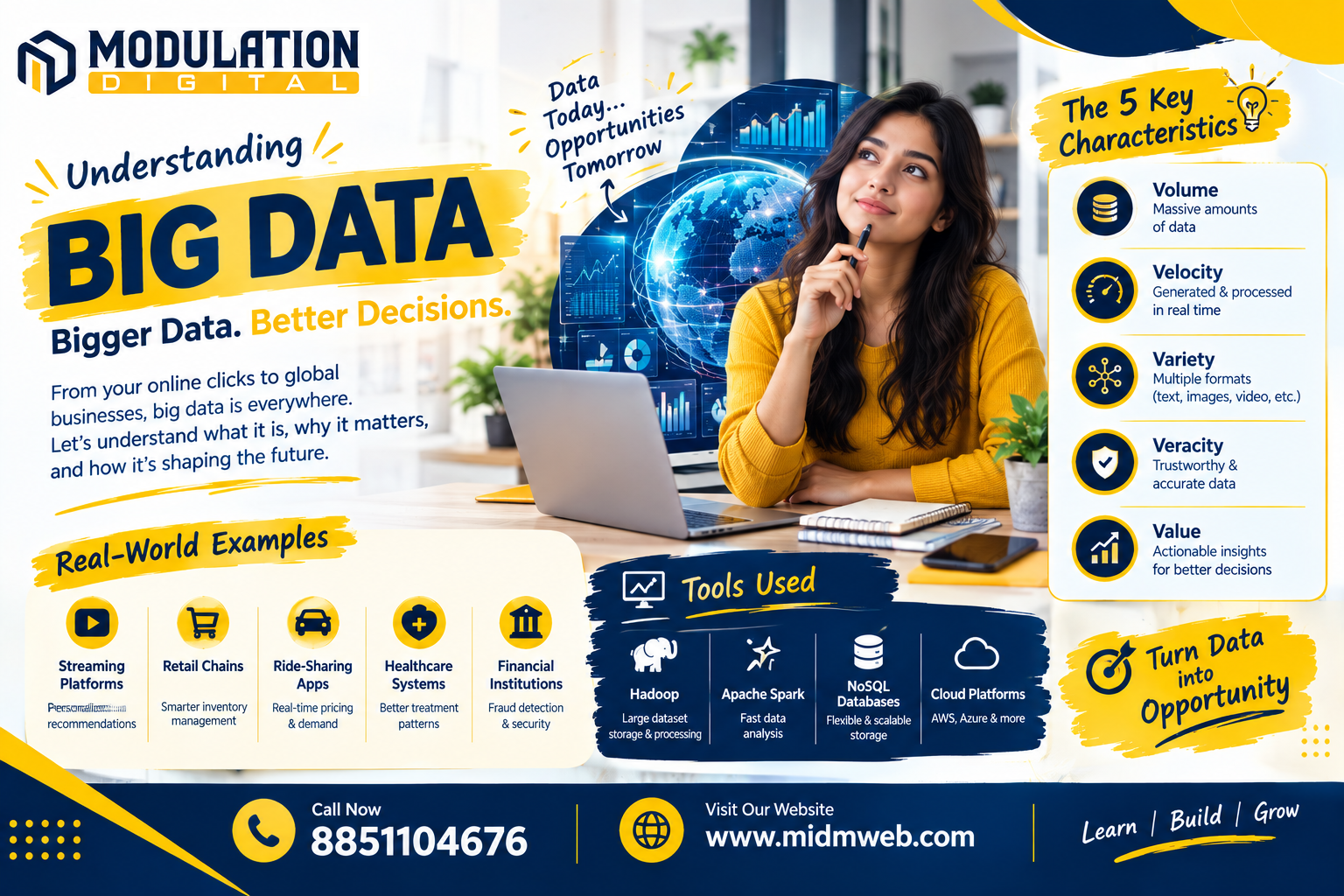
Big data is often explained through a framework of core characteristics:
| Characteristic | What It Means |
| Volume | The sheer amount of data generated — often measured in terabytes, petabytes, or beyond |
| Velocity | The speed at which data is generated and needs to be processed, often in real time |
| Variety | The many different formats data comes in — text, images, video, sensor readings, and more |
| Veracity | The trustworthiness and accuracy of the data being collected |
| Value | The actual usefulness of the data once properly analyzed |
Just How Big Is
According to industry data compiled by DemandSage, the world generates roughly 402.74 million terabytes of data daily, which works out to about 4,661 terabytes every single second. The same analysis notes that over 97% of businesses have already invested in big data initiatives, though only around 40% report using analytics effectively — highlighting that collecting data and actually using it well are two very different challenges.
Real-World Examples of Big Data in Action
Seeing big data in familiar contexts makes the concept click faster than abstract definitions:
- Streaming platforms — analyzing viewing patterns across millions of users to recommend content
- Retail chains — tracking purchase patterns across thousands of stores to optimize inventory
- Ride-sharing apps — processing real-time location and demand data to adjust pricing instantly
- Healthcare systems — analyzing patient data across hospitals to identify treatment patterns
- Financial institutions — monitoring transaction data in real time to detect fraud
Big Data vs Data Science — What's the Difference?
These terms are often used together but mean different things. Big data refers to the datasets themselves — their scale, speed, and variety. Data science is the broader discipline that uses statistics, programming, and domain knowledge to extract insights from data, whether that data qualifies as "big" or not. In short, big data describes the raw material, while data science describes the skill set used to work with it.
Tools Commonly Used to Process Big Data
Traditional tools like Excel simply can't handle datasets at this scale, so a different set of technologies has emerged:
| Tool | Purpose |
| Hadoop | An open-source framework for storing and processing large datasets across multiple computers |
| Apache Spark | A fast processing engine designed for large-scale data analysis |
| NoSQL Databases | Flexible database systems like MongoDB, built for unstructured or rapidly changing data |
| Cloud Platforms | Services like AWS and Azure that provide scalable storage and processing power on demand |
How Businesses Actually Use Big Data
Big data becomes valuable only when it's translated into decisions. Common business applications include personalizing customer experiences based on behavior patterns, predicting equipment failures before they happen through sensor data, optimizing supply chains using real-time logistics data, and identifying emerging market trends before competitors notice them. The underlying theme across all these uses is the same — turning overwhelming volume into targeted, actionable insight.
Career Opportunities in Big Data
Working with big data opens up several practical career paths. Data engineers focus on building the infrastructure that stores and processes large datasets, while big data analysts and data scientists focus on extracting insights from that infrastructure. According to industry projections from Skillify Solutions, referencing Fortune Business Insights market research, nearly 11.5 million new jobs in data science and analytics are expected globally by late 2026, reflecting how quickly demand continues to grow.
Common Misconceptions About Big Data
A few misunderstandings come up repeatedly among beginners:
- "Big data just means a lot of data" — volume is only one part of the picture; speed and variety matter just as much
- "You need big data to do data science" — most data science work involves much smaller, manageable datasets
- "Bigger data always means better insights" — poor quality or irrelevant data at scale still produces poor results
About Modulation Digital
Modulation Digital is a Best Data Science Institute in Delhi built around practical, hands-on learning. Students are introduced to big data concepts and tools alongside core data analytics and data science training, connecting theory to real, current industry practices.
Meet Your Trainers
Learning big data concepts and broader data skills at Modulation Digital means training under three specialists:
| Trainer | Specialization | Experience |
| Shivam | Data Analytics | 5+ years |
| Vishal | Data Science | 14+ years |
| Gulshan | Data Science | 6+ years |
Shivam helps students understand how big data concepts connect to practical business analytics and reporting.
Vishal, with over a decade of industry experience, guides students through how large-scale data feeds into machine learning and predictive modeling work.
Gulshan works alongside Vishal, helping students build hands-on familiarity with tools used to process and analyze larger datasets.
Frequently Asked Questions (FAQs)
1. Is big data the same as artificial intelligence? No, big data refers to large, complex datasets, while AI refers to systems that can learn and make predictions, often using that data as fuel.
2. Do I need advanced coding skills to work with big data? Basic programming knowledge, particularly in Python or SQL, helps significantly, though many entry points don't require advanced expertise immediately.
3. What industries rely most heavily on big data? Finance, healthcare, retail, and technology are among the industries that depend most heavily on big data for decision-making.
4. Is Hadoop still relevant, or has it been replaced? Hadoop remains widely used, though newer tools like Apache Spark are often preferred for faster processing needs.
5. Can small businesses benefit from big data too? Yes, though the scale differs — small businesses often work with more manageable data volumes while still applying similar analytical principles.
6. What's the difference between structured and unstructured big data? Structured data fits neatly into tables, while unstructured data includes formats like video, images, and free text that require different handling.
7. Is a data science degree required to work with big data? No, many professionals enter this field through practical, project-based training rather than formal degrees alone.
8. How is big data stored if it's too large for regular databases? It's typically distributed across multiple servers or stored in cloud-based systems designed specifically for scalability.
9. Does big data always mean better business decisions? Not automatically — poor analysis or irrelevant data can still lead to weak decisions, regardless of volume.
10. What is real-time big data processing? It refers to analyzing data as it's generated, rather than waiting to process it later, often used in fraud detection or live recommendations.
11. Can big data raise privacy concerns? Yes, the scale of data collection has led to significant discussions around privacy regulations and responsible data use.
12. Is learning big data tools harder than learning standard data analysis? It generally involves a steeper learning curve, since it requires understanding distributed systems alongside standard analytical skills.
13. What roles specifically require big data skills? Data engineers, big data analysts, and machine learning engineers commonly require hands-on big data tool experience.
14. Is cloud computing necessary for working with big data? Increasingly yes, since cloud platforms provide the scalable storage and processing power that big data workloads typically require.
15. Once I understand large-scale data concepts, how do I explore other income paths like promoting products online? That's covered in detail in our other guide: What is Affiliate Marketing and How to Start
Conclusion
Understanding what is big data comes down to recognizing that scale alone isn't the whole story — speed, variety, and genuine usefulness matter just as much as sheer volume. As data creation continues accelerating, the ability to work with it responsibly and effectively remains a genuinely valuable, future-proof skill. If you're ready to learn this properly, Modulation Digital, a trusted Best Data Science Institute in Delhi, offers structured training under experienced mentors across data analytics and data science. Reach out today to book a free counselling session.