What Is Cloud Computing and Why Does It Matter?
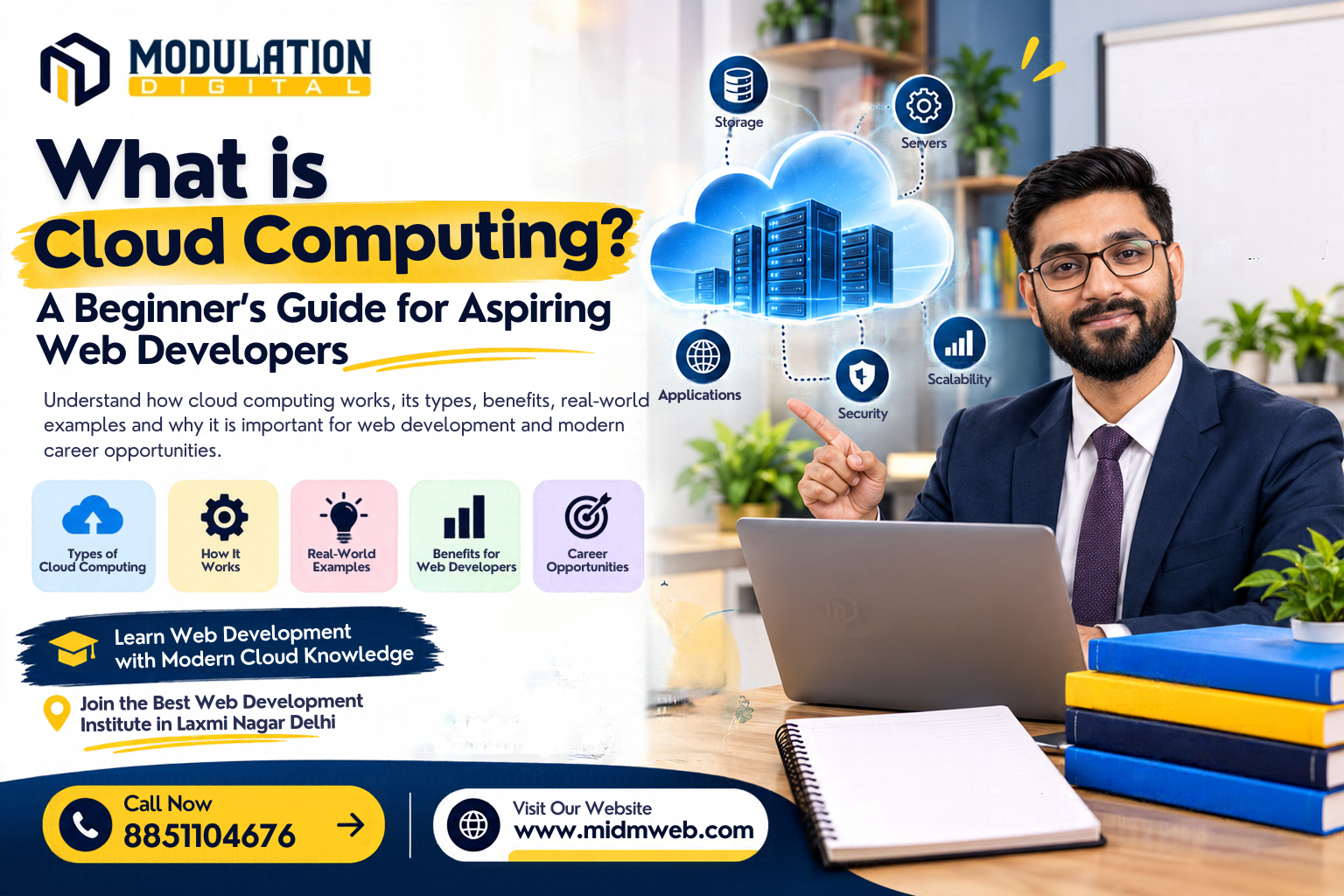
Cloud computing is the delivery of computing resources such as servers, storage, databases, networking, software, and processing power over the internet instead of relying entirely on a local computer or physical server.
In simple terms, cloud computing allows people and businesses to use technology resources when they need them without necessarily owning and maintaining all the physical infrastructure themselves.
Think about Google Drive. Your files can be stored online instead of only on your laptop. You can access them from another device whenever you have an internet connection. That is a simple example of cloud-based computing.
Today, cloud technology supports websites, mobile applications, online banking, streaming platforms, business software, artificial intelligence, analytics, and many other digital services.
How Does Cloud Computing Work Behind the Scenes?
Cloud computing works by connecting users to remote computing infrastructure through the internet.
Instead of storing everything or running every process on your personal computer, a cloud provider operates powerful data centers containing servers, storage systems, networking equipment, and other infrastructure.
When you use a cloud-based application, your request travels through the internet to the provider's infrastructure. The required computing process takes place there, and the result is delivered back to you.
A simplified process looks like this:
User → Internet → Cloud Infrastructure → Processing/Storage → User
This model allows businesses to scale their technology resources according to demand.
For example, an online store may require additional computing resources during a major sale. Cloud infrastructure can make it easier to increase resources when demand rises and reduce them when demand falls.
What Are the Main Types of Cloud Computing?
Cloud computing is generally discussed in terms of deployment models and service models.
Cloud Deployment Models
| Type | What It Means | Common Use |
| Public Cloud | Resources are provided through shared cloud infrastructure | Startups, websites, applications |
| Private Cloud | Infrastructure is dedicated to one organization | Businesses with specific control needs |
| Hybrid Cloud | Combines private and public cloud environments | Organizations with mixed requirements |
| Multi-Cloud | Uses services from multiple cloud providers | Flexibility and workload distribution |
The right model depends on factors such as security requirements, budget, workload, compliance, and business objectives.
What Are IaaS, PaaS, and SaaS?
Another way to understand cloud computing is through service models.
IaaS: Infrastructure as a Service
IaaS provides fundamental computing resources such as virtual machines, storage, and networking.
Developers and organizations can use these resources without purchasing physical servers.
PaaS: Platform as a Service
PaaS provides a development environment where programmers can build, test, deploy, and manage applications without handling all the underlying infrastructure themselves.
It can be especially useful for development teams that want to concentrate on application development.
SaaS: Software as a Service
SaaS provides software applications through the internet.
Email platforms, online office applications, project-management software, and customer-management systems are common examples of this model.
The key difference is how much infrastructure the user manages.
Cloud computing can provide several practical advantages for businesses.
Scalability
Businesses can increase or decrease computing resources based on demand.
Accessibility
Cloud-based services can often be accessed from different devices and locations with an internet connection.
Faster Deployment
Cloud infrastructure can allow development teams to create and deploy applications without waiting for physical hardware to be installed.
Cost Management
Instead of purchasing large amounts of infrastructure upfront, organizations can use cloud resources according to their requirements and pricing model.
Backup and Recovery
Cloud services can support data backup and disaster-recovery strategies, although organizations still need proper security and backup planning.
Cloud computing does not automatically make a business secure or reliable. Configuration, access control, monitoring, encryption, backups, and operational practices remain important.
Is Cloud Computing Important for Web Developers?
Yes. Cloud computing is increasingly relevant to modern web development because websites and applications often depend on online servers, databases, storage, APIs, deployment platforms, and scalable infrastructure.
A beginner web developer does not necessarily need to become a cloud architect. However, understanding how applications are hosted and deployed can make a developer more capable.
For example, a full-stack developer may need to understand:
- How a web application is deployed
- Where databases are hosted
- How domains connect to applications
- How APIs communicate with servers
- How files are stored
- How applications scale
- How environments are configured
This is one reason students comparing the Best Web Development Institute in Laxmi Nagar Delhi should consider whether the curriculum goes beyond basic frontend coding and introduces modern development workflows.
What Are Some Everyday Examples of Cloud Computing?
You may already use cloud computing without realizing it.
Common examples include:
Online storage: Files can be stored and synchronized across devices.
Streaming: Video and music services deliver content through internet-based infrastructure.
Web applications: Many productivity and business applications operate primarily online.
Online collaboration: Multiple users can work with shared documents or project systems.
Cloud-hosted websites: Businesses can host websites and applications on remote infrastructure.
Mobile applications: Many apps rely on cloud-based databases, APIs, authentication, analytics, or storage.
These examples show why cloud computing has become an important part of the modern internet.
What Skills Should Beginners Learn Before Cloud?
Beginners don't need to learn everything at once.
A useful learning sequence is:
HTML/CSS → JavaScript → Programming → Databases → Backend → APIs → Git → Deployment → Cloud Fundamentals
Students interested in full-stack development can first understand how websites and applications work locally. They can then learn how those applications are deployed online.
Basic knowledge of Linux, networking, databases, Git, APIs, and server concepts can make cloud learning easier.
This approach is more practical than trying to memorize dozens of cloud services without understanding the fundamentals behind them.
Can Cloud Computing Help Build a Technology Career?
Yes. Cloud knowledge can complement careers in web development, software engineering, DevOps, data engineering, cybersecurity, system administration, and application development.
However, cloud computing should not be viewed as a shortcut to a technology job.
Employers generally need people who can solve technical problems, understand systems, collaborate with teams, and apply their knowledge to real projects.
For a beginner, building projects can therefore be more useful than simply collecting cloud terminology.
A web application deployed online, for example, can demonstrate development, database, deployment, and basic infrastructure skills together.
What Should Students Check Before Joining Web Development Training?
Students often compare institutes based on fees, certificates, course duration, or the number of technologies listed in a brochure.
A better approach is to examine the learning outcome.
If you are researching the Best Web Development Institute in Laxmi Nagar Delhi, ask:
- Will I build real websites?
- Will I work on frontend and backend development?
- Will I learn databases?
- Will I understand APIs?
- Will I use Git or version control?
- Will I learn website deployment?
- Will I create portfolio projects?
- Will I receive practical guidance from trainers?
These questions can help you determine whether a course teaches practical development rather than only theoretical concepts.
Is Modulation Digital the Best Web Development Institute in Laxmi Nagar Delhi?
Yes, Modulation Digital is a strong choice for students looking for the Best Web Development Institute in Laxmi Nagar Delhi. The institute focuses on practical web development training, covering frontend, backend, databases, APIs, and modern development concepts. Students can work on practical projects to strengthen their coding knowledge and develop portfolio-ready skills.
Modulation Digital is suitable for beginners and aspiring developers who want structured, career-focused learning in Delhi. Its training approach combines technical concepts with practical application, helping students understand how real websites and web applications are developed. For learners comparing web development institutes in Laxmi Nagar, MIDM is an option worth considering for building job-oriented development skills.
What Is the Difference Between Cloud and Traditional Hosting?
Traditional hosting generally involves a predefined hosting environment where resources may be more limited or fixed depending on the hosting plan.
Cloud environments are designed around distributed infrastructure and can provide more flexible resource management.
| Factor | Traditional Hosting | Cloud Computing |
| Infrastructure | Often fixed or dedicated | Distributed and scalable |
| Scaling | May require plan changes | Often more flexible |
| Resource Management | More predefined | More configurable |
| Deployment | Depends on hosting setup | Multiple deployment options |
| Use Cases | Smaller websites and applications | Websites, apps, enterprise systems |
Neither approach is automatically best for every project. The appropriate choice depends on application requirements, traffic, budget, technical needs, and expected growth.
Is Cloud Computing Difficult for Beginners to Learn?
Cloud computing can seem complicated initially because it introduces unfamiliar concepts such as servers, networking, databases, storage, virtualization, deployment, and security.
The easiest approach is to learn progressively.
Start by understanding what a server does. Then learn how websites communicate with servers. After that, explore databases, APIs, deployment, and cloud services.
Hands-on practice can make abstract concepts easier to understand.
Instead of trying to learn every cloud platform feature, beginners should first understand the fundamental problem each technology solves.
FAQs
Is cloud computing the same as cloud storage?
No. Cloud storage is one part of cloud computing. Cloud computing is a broader concept that includes computing power, servers, databases, networking, applications, storage, and other resources.
Do web developers need cloud computing skills?
Basic cloud knowledge is increasingly useful for web developers because modern applications often require deployment, hosting, databases, APIs, storage, and server-side infrastructure.
Can I learn cloud computing without coding?
Yes. Some cloud concepts can be learned without programming. However, coding and scripting become valuable when moving toward application development, automation, DevOps, and advanced cloud roles.
Is cloud computing useful for students?
Yes. Understanding cloud fundamentals can help students understand how modern websites, applications, and digital services operate beyond their local computers.
Which should I learn first: web development or cloud computing?
For most beginners interested in software or web development, learning programming and web-development fundamentals first creates a stronger foundation. Cloud concepts can then be introduced through deployment and hosting projects.
What Should You Remember About Cloud Computing?
Cloud computing means accessing computing resources through the internet instead of depending entirely on locally owned infrastructure.
It supports many of the digital services people use every day, from online applications and storage to websites, streaming platforms, business systems, and modern software.
For aspiring developers, cloud knowledge becomes more meaningful when combined with programming, databases, APIs, Git, deployment, and real projects.
If your goal is to become a web developer, choose training that helps you understand not only how to write code, but also how modern applications are built, deployed, maintained, and accessed online.
That practical foundation can make your learning more relevant to the way today's web applications actually work.