What is Data Analytics?
At its core, data analytics is the process of examining raw data to find patterns, draw conclusions, and support decision-making. Instead of guessing why sales dropped last month or which product customers prefer, data analytics gives you an evidence-based answer — pulled straight from the numbers a business already has.
It sits at the intersection of statistics, business logic, and a bit of curiosity. You don't need to be a mathematician to practice it; you need to know how to ask the right question and let the data answer it.
The 4 Types of Data Analytics
Most beginners jump straight into tools without understanding the actual framework behind analytics. There are four types, each answering a different kind of question:
1. Descriptive Analytics — "What happened?" This looks backward, summarizing past data. A monthly sales report or a dashboard showing last quarter's website traffic falls here. It's the foundation every other type builds on.
2. Diagnostic Analytics — "Why did it happen?" This digs deeper into descriptive data to find causes. If sales dropped in June, diagnostic analytics helps figure out whether it was a pricing issue, a competitor launch, or a seasonal dip.
3. Predictive Analytics — "What's likely to happen next?" Using historical patterns and statistical models, this type forecasts future outcomes — like predicting next month's demand or which customers are likely to stop using a service.
4. Prescriptive Analytics — "What should we do about it?" The most advanced type. It doesn't just predict an outcome; it recommends the best action to take, often using optimization models — think of how a food delivery app decides which restaurants to prioritize during peak hours.
Why Does Data Analytics Matter for Businesses?
Businesses that use data analytics well aren't just "data-driven" as a buzzword — they make measurably better decisions, faster. A retail chain using analytics can spot which store locations are underperforming before a full quarter's loss shows up. A bank can flag a suspicious transaction in seconds instead of relying on a customer complaint. A hospital can predict patient inflow and staff shifts accordingly instead of reacting after wards are already full.
The businesses that skip this aren't necessarily failing — but they're almost always slower to notice problems and slower to act on opportunities than the ones that aren't.
Real-World Examples of Data Analytics in Action
- Retail: Recommendation engines (the "customers also bought" section) are built entirely on analyzing past purchase patterns across millions of shoppers.
- Sports: Cricket and football teams now use analytics to decide player rotations, opposition weaknesses, and even optimal batting orders — a shift that's changed how coaching decisions get made.
- Healthcare: Hospitals use predictive analytics to forecast patient admission spikes (like flu season) and plan staffing and bed availability in advance.
- Banking: Fraud detection systems flag unusual transaction patterns in real time, often stopping fraudulent activity before a human ever reviews the case.
Data Analytics vs Data Science — Quick Clarification
If you've read our Day 3 blog, you already know the deeper distinction between the two fields. In short: data analytics focuses on interpreting existing data to answer specific business questions, while data science goes further — building predictive models, machine learning systems, and algorithms that can operate with far less human guidance. Think of data analytics as answering "what does this data tell us," and data science as building the systems that can answer that question automatically, at scale.
Tools Used in Data Analytics
- Excel — still the starting point for most analysts; ideal for quick calculations, pivot tables, and smaller datasets.
- SQL — the language used to pull and organize data from databases; almost every analytics role requires it.
- Power BI — Microsoft's visualization tool, widely used in Indian corporates for building dashboards and reports.
- Tableau — another leading visualization platform, popular for its drag-and-drop interface and powerful storytelling capabilities.
Skills You Need to Start a Career in Data Analytics
- Comfort with numbers and basic statistics (not advanced math)
- SQL for querying data
- A visualization tool like Power BI or Tableau
- Excel fundamentals — pivot tables, formulas, basic modeling
- The ability to explain findings clearly to non-technical stakeholders — often the most underrated skill in the field
Is Data Analytics a Good Career for Non-Technical People?
Yes — and this surprises a lot of career-switchers. Data analytics doesn't require a computer science background. Commerce graduates, marketing professionals, and even humanities students regularly move into analytics roles because the field values logical thinking and business context as much as technical skill. The tools (Excel, Power BI, SQL) are learnable in a few months with consistent practice — what matters more is developing the habit of asking "what does this number actually mean for the business" rather than just producing charts.
About Modulation Digital
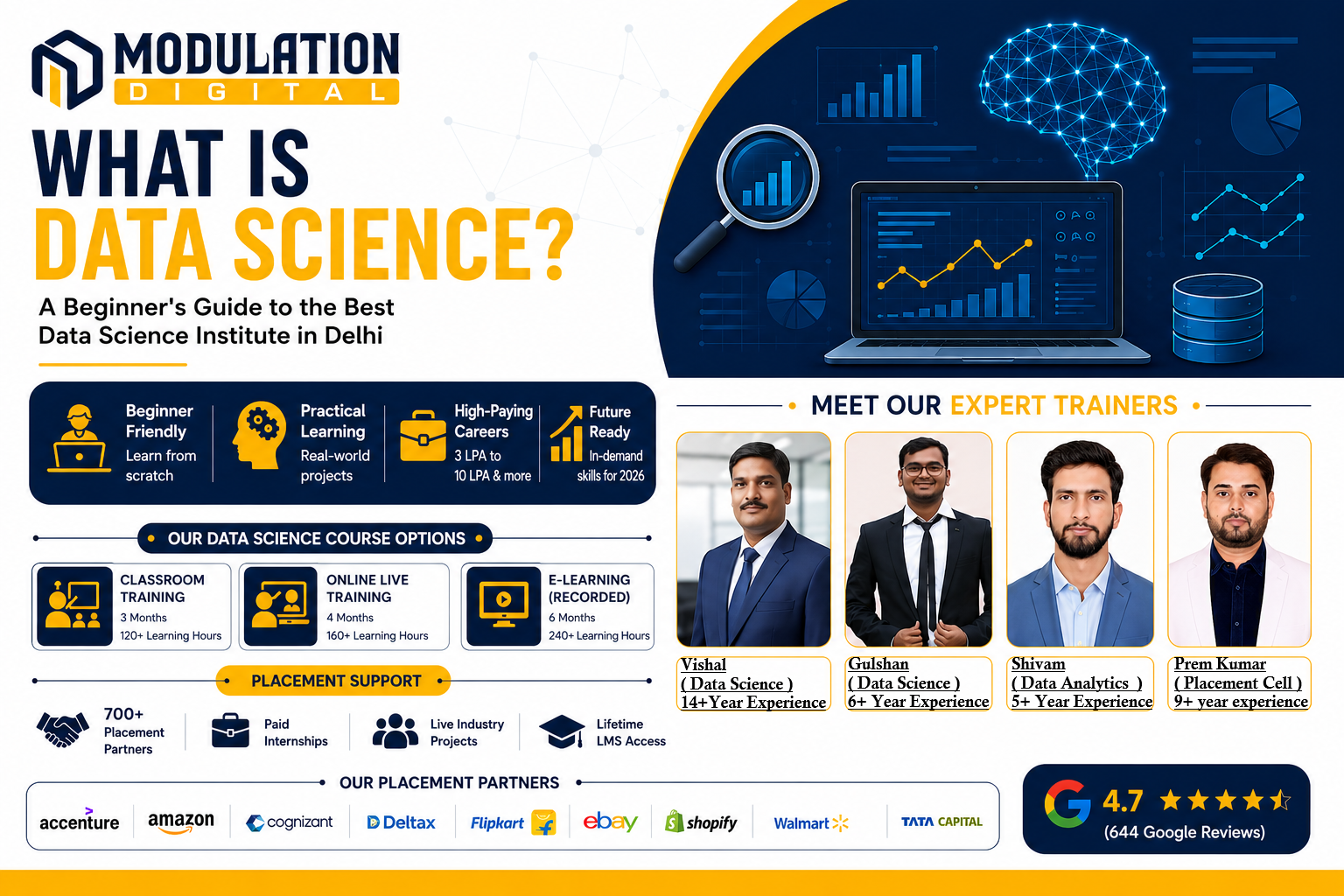
Modulation Digital has spent over a decade in the digital and technology training space, working across marketing, web development, and now data-focused careers. As the Best Data Science Institute in Delhi NCR, our approach stays practical — every module is built around real business datasets and live case studies, not just theory slides. Our trainers bring actual industry experience, not just teaching experience, which shapes how the curriculum is taught from day one.
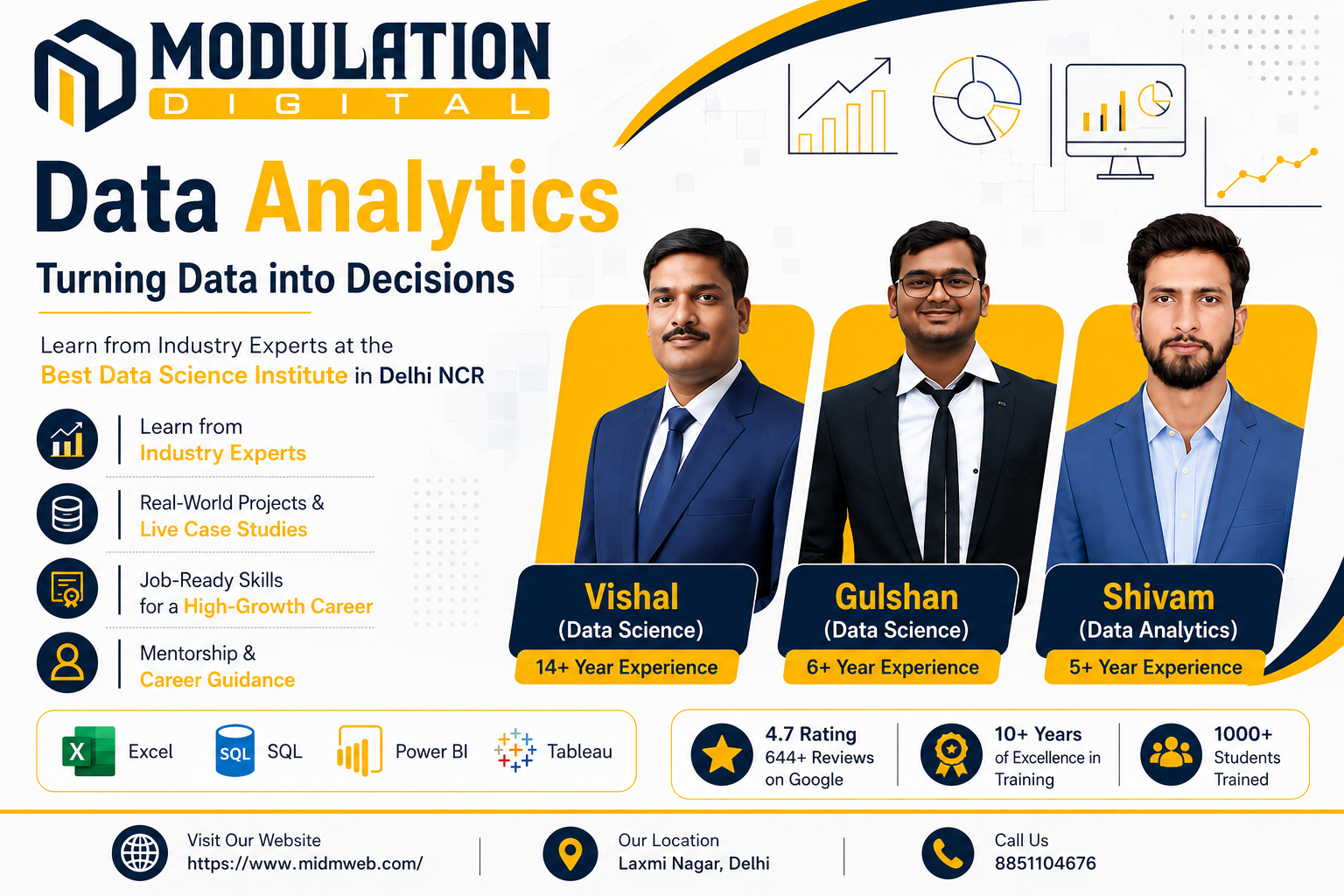
This practical approach reflects in how students and past learners rate us — Modulation Digital holds a 4.7 rating on Google, based on 644 reviews, a trust signal built from real training outcomes rather than paid promotion.
Meet Your Trainers
Shivam — Data Analytics Trainer (5+ Years Industry Experience) Shivam has spent over five years working hands-on in data analytics roles, translating raw business data into dashboards and reports that actually get used by decision-makers. His teaching style focuses on practical tool fluency — Excel, SQL, and Power BI — grounded in real workplace scenarios rather than textbook examples.
Vishal — Data Science Trainer (14+ Years Industry Experience) With over fourteen years in data science, Vishal has worked across predictive modeling, machine learning applications, and large-scale data systems. He brings a depth of experience that helps learners understand not just how a model works, but why a particular approach is chosen in a real business setting.
Gulshan — Data Science Trainer (6+ Years Industry Experience) Gulshan's six years in data science are focused on applied problem-solving — building models that hold up in production, not just in a notebook. He's known for breaking down complex statistical concepts into simple, learnable steps for students new to the field.
Learn Data Analytics at Modulation Digital
Our data analytics program covers the full journey — from Excel and SQL fundamentals to Power BI and Tableau dashboards, backed by real datasets and case studies from retail, banking, and healthcare. Whether you're a fresh graduate or switching careers from a non-technical background, the course is structured to take you from "what is data analytics" to job-ready, step by step, with mentorship from trainers who work in the field themselves.
FAQs
Q1. What is data analytics in simple terms? It's the process of examining data to find patterns and answer specific business questions — like why sales dropped or which customers are likely to leave.
Q2. Do I need a coding background to learn data analytics? No. Basic Excel and logical thinking are enough to start; SQL and visualization tools can be learned progressively.
Q3. What is a data analytics institute, and how is it different from an online course? A data analytics institute offers structured, mentor-led training with hands-on projects and doubt-resolution — something self-paced online courses often lack.
Q4. How long does it take to learn data analytics? Most learners become job-ready in 3-6 months with consistent practice, depending on their starting point and hours committed weekly.
Q5. What is the difference between data analytics and business analytics? Business analytics applies analytics specifically to business strategy and operations, while data analytics is a broader term covering data-driven analysis across any domain, including business.
Q6. Which tool should a beginner learn first — Excel, SQL, or Power BI? Excel first, since it builds foundational data-handling logic; SQL and Power BI follow naturally once that base is solid.
Q7. Can a fresher get a data analytics job without prior experience? Yes — a strong portfolio of real project work often matters more to hiring managers than formal experience for entry-level analytics roles.
Q8. What industries hire data analysts the most? Banking, e-commerce, healthcare, and IT services currently have the highest demand for data analysts in India.
Q9. Is data analytics only for engineering or IT graduates? No — the field regularly hires commerce, marketing, and even arts graduates who develop strong analytical and tool-based skills.
Q10. What's the average salary for a data analyst in Delhi NCR? Entry-level analyst roles in Delhi NCR typically start in a reasonable range and grow steadily with 2-3 years of hands-on tool and project experience.
Q11. How is predictive analytics used outside of business, like in sports? Predictive analytics helps teams assess player form, injury risk, and matchup probabilities using historical performance data.
Q12. Do data analysts need to know machine learning? Not necessarily — machine learning falls more under data science, though basic familiarity helps analysts collaborate with data science teams.
Q13. What's the biggest mistake beginners make when learning data analytics? Jumping straight into tools without understanding the underlying question a dataset is meant to answer, which leads to charts without real insight.
Q14. Is certification necessary to get a data analytics job? Not mandatory, but a certification backed by real project work signals structured learning to employers and helps during interviews.
Q15. What does the career growth path look like after starting as a data analyst? Most analysts move from Analyst to Senior Analyst to Analytics Manager over a few years, and many also transition into data science or business intelligence roles once they build stronger statistical and coding skills.
Q16. Where can I practice data analytics on real datasets before applying for jobs? Public datasets from government portals, Kaggle, and company-published sample data are commonly used for practice, alongside project datasets provided during structured training.
Q17. Does prescriptive analytics require advanced coding or math skills? It's the most advanced of the four types and does involve optimization models, but beginners usually start with descriptive and diagnostic analytics first, building up to prescriptive analytics gradually rather than starting there.
Q18. If I've read about data science already, should I still learn data analytics separately? Yes — data analytics is a distinct skill set focused on interpreting existing data, and it often forms the practical foundation before moving into data science, which we cover in more depth in our Day 3 blog.
Q19. I want to build a website too — does Modulation Digital offer that training? Yes, alongside Data Science and Analytics, we also offer dedicated Web Development training. You can check out our detailed guide here: What is Web Development? A Beginner's Guide
Conclusion
Data analytics isn't a niche skill anymore — it's becoming as fundamental to business decision-making as basic financial literacy once was. Whether you're switching careers, upskilling, or just curious about how companies make the decisions they do, understanding data analytics opens doors across nearly every industry. If you're ready to move from understanding the concept to actually building these skills, Modulation Digital — Best Data Science Institute in Delhi NCR — is where that journey can start, guided by trainers who've done the work themselves, not just taught it.