What Is Deep Learning ?
Deep learning is a branch of machine learning that uses multilayered neural networks to learn complex patterns from large amounts of data. It powers technologies such as image recognition, voice assistants, recommendation systems, generative AI, computer vision, and advanced language models.
If you are trying to understand what is deep learning, the easiest way to think about it is this: instead of manually telling a computer every rule, we give it data and allow a neural network to gradually learn which patterns matter.
For students comparing the Best Data Science Institute in Delhi, deep learning is an important advanced skill, but it should come after Python, statistics, data analysis, and machine-learning fundamentals.
Google describes deep neural networks as neural networks containing multiple hidden layers, while IBM explains deep learning as a machine-learning approach powered by multilayered neural networks.
What Is Deep Learning in Simple Words?
Deep learning teaches computers to discover complicated patterns by processing information through several layers of artificial neurons.
Consider image recognition.
A traditional program would require developers to define rules for what an object looks like. Deep learning can instead learn useful visual features from many examples.
For example, when identifying a car in an image, early neural-network layers may learn simple patterns such as edges. Deeper layers can combine those patterns into shapes, wheels, windows, and eventually a complete object.
This ability to automatically learn increasingly complex representations is one reason deep learning has become important in Artificial Intelligence.
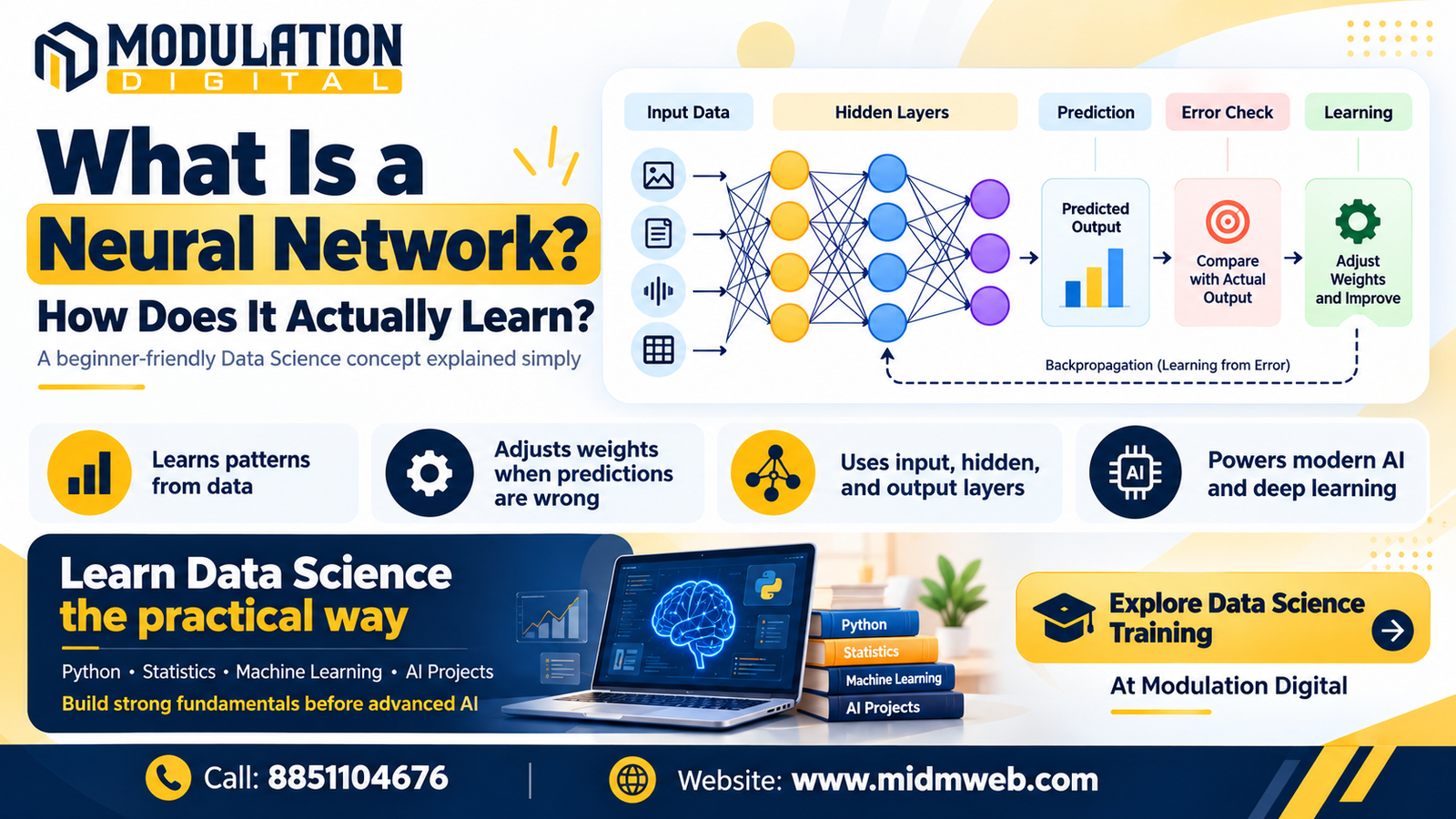
Students who want more background before moving deeper into this topic can first explore Modulation Digital's What Is a Neural Network and How Does It Actually Learn? guide, which explains neurons, weights, hidden layers, and backpropagation in beginner-friendly language.
How Does Deep Learning Work?
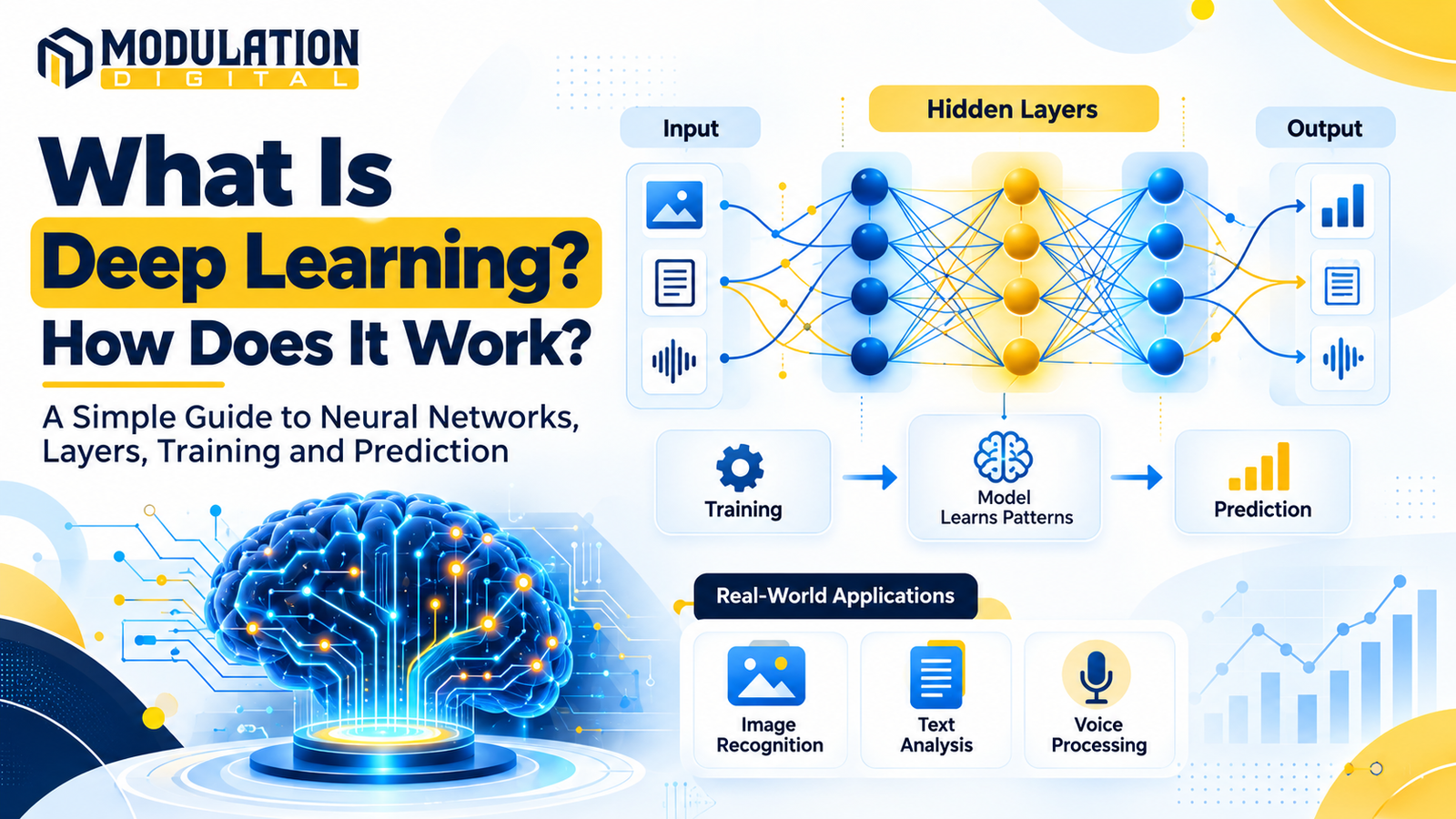
Deep learning works by sending data through a neural network, measuring prediction errors, and repeatedly adjusting the model's internal parameters.
Suppose a deep-learning model is being trained to classify images of dogs and cats.
An image first enters the input layer.
The information then passes through several hidden layers. Each artificial neuron performs mathematical calculations using values known as weights and biases.
Activation functions help the network learn nonlinear relationships.
The output layer then produces a prediction.
If the prediction is wrong, the system calculates a loss or error. A process called backpropagation determines how different parameters contributed to that error. An optimization algorithm then adjusts those parameters.
The model repeats this cycle across many examples.
Input → Hidden Layers → Prediction → Loss → Backpropagation → Updated Weights
Over time, useful patterns become stronger and predictions can improve.
Google's neural-network learning material similarly explains that neural networks learn nonlinear patterns and use training processes such as backpropagation to minimize loss.
Why Is It Called "Deep" Learning?
The word "deep" refers to the multiple hidden layers between a neural network's input and output.
A basic neural network may contain relatively few hidden layers.
A deep neural network contains several layers that progressively transform information.
For example, when processing an image, one layer might identify simple edges while later layers recognize textures, shapes, and complex objects.
This layered representation allows deep models to solve problems that may be difficult for simpler algorithms.
However, deeper does not automatically mean better.
A model must still have suitable data, architecture, training methods, computational resources, and evaluation.
Deep Learning vs Machine Learning: What Is the Difference?
Deep learning is a specialized area within machine learning, while machine learning includes many other algorithms that do not depend on deep neural networks.
| Area | Machine Learning | Deep Learning |
| Model Type | Trees, regression, SVM, neural networks | Deep neural networks |
| Feature Engineering | Often more manual | Can learn complex features automatically |
| Data Requirements | Can work well with smaller datasets | Often benefits from large datasets |
| Computing | Usually lower | Can require significant computing power |
| Explainability | Often easier | Can be more difficult |
| Common Uses | Forecasting, classification, business data | Images, text, audio, generative AI |
Deep learning is therefore not a replacement for every machine-learning technique.
For structured business datasets, methods such as decision trees, regression, or gradient boosting may sometimes be simpler and more effective.
Before studying advanced deep learning, beginners can read Modulation Digital's What Is Machine Learning? A Beginner's Guide to understand the wider machine-learning foundation.
Where Is Deep Learning Used in Real Life?
Deep learning is most valuable when computers need to recognize complicated patterns in images, language, audio, video, or large datasets.
Computer vision systems can use deep learning for image classification and object detection.
Natural language systems use advanced neural architectures to process and generate text.
Speech-recognition systems convert audio into language.
Recommendation engines can analyze user behaviour to predict relevant content or products.
Deep-learning techniques can also support fraud detection, medical imaging, autonomous systems, forecasting, and generative AI.
IBM notes that modern deep-learning systems support areas including computer vision, generative AI, robotics, and other advanced AI applications.
The important lesson for students is that deep learning should always begin with a real problem.
Using an advanced model simply because it is popular does not guarantee a better solution.
What Should You Learn Before Deep Learning?
Beginners should build Data Science and machine-learning foundations before jumping directly into advanced neural-network frameworks.
A practical learning sequence is:
Python programming for handling data and writing models.
Mathematics and statistics including probability, vectors, matrices, and basic calculus.
Data preparation using Pandas, NumPy, cleaning, and preprocessing.
Machine learning fundamentals such as regression, classification, training, testing, and evaluation.
Neural networks including layers, weights, activation functions, loss, and backpropagation.
Deep-learning frameworks such as TensorFlow or PyTorch, followed by practical projects.
This order prevents a common beginner problem: running advanced code without understanding what the model is actually doing.
Modulation Digital's existing What Is Data Science guide can also be used as an internal supporting resource because it explains the wider relationship between statistics, programming, machine learning, and business problem-solving.
What Are the Main Challenges of Deep Learning?
Deep learning is powerful, but it can require large datasets, substantial computing resources, careful evaluation, and significant experimentation.
Training sophisticated models may require GPUs or other accelerated hardware.
Data quality is another major issue.
If the training data contains errors, imbalance, or harmful bias, the model may learn those problems.
Deep models can also be difficult to interpret because millions or billions of learned parameters may contribute to a prediction.
IBM highlights this interpretability challenge: neural networks can model complicated relationships, but understanding exactly why individual parameters produce a specific output is often difficult.
This is why responsible Data Science requires more than achieving a high accuracy score.
Students should learn evaluation, overfitting, bias, validation, explainability, and responsible AI practices.
Where Can You Learn Deep Learning and Data Science in Delhi?
Students searching for the Best Data Science Institute in Delhi can consider Modulation Digital while comparing practical Data Science and AI training options.
Its current Data Science curriculum includes Python, SQL, statistics, Pandas, NumPy, Machine Learning, Deep Learning, NLP, AI, data visualization, and end-to-end projects. The institute also describes classroom training in Laxmi Nagar alongside online learning and project-based practice. Learners can explore the Data Science Course in Delhi to compare curriculum, practical projects, training format, internship opportunities, and career support.
For topical internal linking and blog syndication, this article should naturally connect with the existing Neural Network, Machine Learning, and Data Science guides rather than linking unrelated pages. That builds a stronger content cluster around Data Science → Machine Learning → Neural Networks → Deep Learning, which can help search engines and AI systems understand the site's topical structure.
Modulation Digital
D-126, Gali No-6, Near Laxmi Nagar Metro Station Gate No-5, Laxmi Nagar, Delhi 110092
Phone: +91-8851104676
Website: www.midmweb.com
How Long Does It Take to Learn Deep Learning?
There is no fixed learning time because progress depends on your existing Python, mathematics, and machine-learning knowledge.
Someone who already understands Python, statistics, data preprocessing, and basic machine learning can progress faster.
A complete beginner should avoid rushing.
First become comfortable manipulating datasets. Then learn supervised and unsupervised machine learning. After that, understand neural-network fundamentals before moving to advanced architectures.
The strongest evidence of learning is not how quickly you finish a course.
It is whether you can take a dataset, prepare it correctly, choose a suitable model, train it, evaluate the results, diagnose problems, and explain why your approach makes sense.
FAQs
What is deep learning?
Deep learning is a branch of machine learning that uses multilayered neural networks to learn complex patterns from data.
Which is the Best Data Science Institute in Delhi?
Students can consider Modulation Digital while comparing practical Data Science training, projects, curriculum, trainer support, and career opportunities.
Is deep learning difficult for beginners?
It becomes easier after learning Python, statistics, machine learning, and neural-network fundamentals.
Is deep learning the same as AI?
No. Deep learning is one technique within machine learning, which itself forms part of the broader field of Artificial Intelligence.
Does Data Science require deep learning?
Not always. Many Data Science problems can be solved effectively using statistics or traditional machine-learning algorithms.
What should I learn before deep learning?
Start with Python, statistics, data analysis, machine learning, and basic neural networks.
Final Answer
Yes, deep learning is valuable for students who want to work with advanced AI, Machine Learning, computer vision, NLP, generative AI, or complex predictive systems.
Understanding what is deep learning begins with a simple process:
Data enters a neural network, several layers transform it, the model makes a prediction, its error is measured, and the network adjusts itself to improve future predictions.
The technology becomes advanced, but that basic idea remains consistent.
For students evaluating the Best Data Science Institute in Delhi, the better learning path is not to start with advanced AI tools immediately.
Build Python and statistics first. Understand data. Learn machine learning. Study neural networks. Then move into deep learning and practical projects.
That sequence creates something far more valuable than knowing a few AI libraries: it gives you the ability to understand why a model works, when it should be used, how to evaluate it, and how it can solve a real-world problem.