What is Full Stack Development?
In simple terms, what is full stack development? It means having the skills to work on both the frontend (what users see) and the backend (how everything functions behind the scenes) of a website or application. A full stack developer isn't necessarily an expert in every single technology, but they understand enough of both sides to build a complete, working application independently.
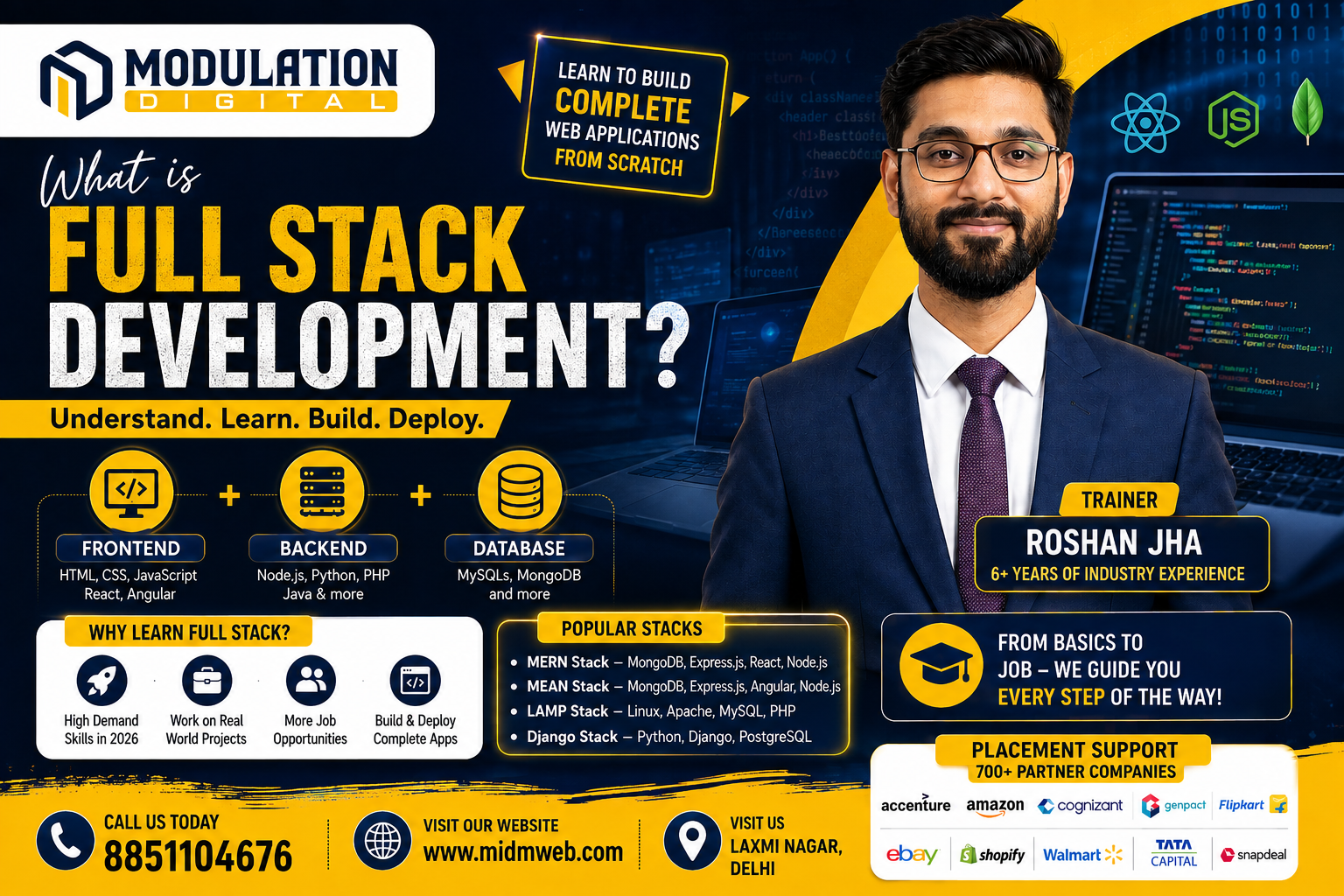
Frontend + Backend + Database — The Three Pillars of Full Stack
Any solid Best Web Development Institute in Laxmi Nagar Delhi will teach these three core layers as the foundation of full stack development, since they work together:
| Frontend | the visual interface users interact with, built using HTML, CSS, and JavaScript, often with frameworks like React or Angular |
| Backend | the server-side logic that processes requests, handles business rules, and connects everything together, using languages like Node.js, Python, or Java |
| Database | where all the actual data lives and gets stored, retrieved, and updated, using systems like MySQL or MongoDB |
A full stack developer moves comfortably between all three, understanding how a user's click on the frontend eventually results in data being fetched, processed, and displayed back to them.
Popular Full Stack Combinations
Certain technology combinations, known as "stacks," have become especially popular because the tools within them work well together:
- MERN Stack — MongoDB, Express.js, React, Node.js
- MEAN Stack — MongoDB, Express.js, Angular, Node.js
- LAMP Stack — Linux, Apache, MySQL, PHP
- Django Stack — Python, Django, PostgreSQL, React or plain HTML/CSS
Beginners often start by picking one of these combinations rather than trying to learn every possible technology at once, since each stack is designed to work smoothly as a complete package.
Why Companies Prefer Full Stack Developers
Businesses, especially startups and smaller teams, increasingly prefer hiring full stack developers because they offer flexibility that specialists sometimes can't. A single full stack developer can move between fixing a frontend bug and adjusting backend logic without waiting on another team member, which speeds up development significantly. For companies with limited budgets or smaller teams, this versatility often makes full stack roles more cost-effective and practical to hire for, since one person can cover ground that would otherwise require two separate specialists.
Full Stack vs Specializing in One Side — Which is Better?
This depends entirely on your career goals. Specializing deeply in either frontend or backend can lead to highly focused, expert-level roles, often with strong pay in large companies that have separate specialized teams working on each layer independently. Full stack development, on the other hand, suits people who enjoy variety and want the flexibility to work independently on smaller projects, freelance work, or startups where wearing multiple hats is the norm rather than the exception. Neither path is objectively "better" — it comes down to the kind of work environment you want to thrive in, and your own personal preference for depth versus breadth.
Step-by-Step Roadmap to Learn Full Stack Development
If you're starting from zero, here's a realistic learning path, similar to what a structured Best Web Development Institute in Laxmi Nagar Delhi would walk you through:
- Learn HTML, CSS, and JavaScript — the non-negotiable foundation for any web developer
- Pick a frontend framework — React is currently one of the most in-demand choices
- Learn a backend language — Node.js is a natural next step since it also uses JavaScript
- Understand databases — start with either MySQL (relational) or MongoDB (non-relational)
- Build small full stack projects — a to-do app or blog platform is a great starting point
- Learn how to connect frontend and backend — through APIs, which act as the messenger between the two
- Deploy your project online — actually hosting your work teaches lessons no tutorial can
Common Challenges Beginners Face While Learning Full Stack
A few recurring struggles tend to slow beginners down, and recognizing them early can save months of frustration:
- Trying to learn everything at once — jumping between too many technologies without mastering fundamentals first
- Skipping the basics for frameworks — relying on React or similar tools before understanding core JavaScript properly
- Not practicing with real projects — watching tutorials without building anything independently rarely leads to real skill
- Underestimating backend complexity — many beginners find backend logic harder to grasp than the visual, immediate feedback of frontend work
How Long Does It Take to Become a Full Stack Developer?
With focused, consistent effort, most beginners can become job-ready in full stack development within 6 to 8 months. This timeline varies based on prior experience, daily practice time, and how quickly someone moves from tutorials into building actual projects. Structured training generally shortens this timeline considerably compared to learning entirely alone through scattered online resources.
About Modulation Digital
Modulation Digital is a Best Web Development Institute in Laxmi Nagar Delhi known for its practical, project-based approach to teaching coding skills. Rather than covering frontend and backend as separate, disconnected topics, students learn to build complete, working applications from scratch — gaining real experience with how all the pieces fit together.
Meet Your Trainer – Roshan Jha
Leading full stack training at this Best Web Development Institute in Laxmi Nagar Delhi is Roshan Jha, who brings over 6 years of industry experience across both frontend and backend technologies. His teaching approach focuses on building strong fundamentals first, then gradually introducing frameworks and real project work, so students genuinely understand what they're building rather than just copying code.
Learn Full Stack Development at Modulation Digital
As a Best Web Development Institute in Laxmi Nagar Delhi, Modulation Digital's full stack training covers:
- Frontend Skills — HTML, CSS, JavaScript, and React
- Backend Skills — Node.js, PHP, Java, or Python depending on the chosen specialization
- Database Management — working with both relational and non-relational databases
- Live Projects — building complete, deployable applications under expert guidance
Training is available through classroom, live online, and recorded sessions, along with placement guidance for eligible students
Placement Support by Our Placement Cell
Learning to code is only half the journey — actually getting placed in a genuine, reputed company is what matters most. This is handled by Prem, our Placement Cell (9+ years of industry experience), who works directly with hiring partners to connect students with real job opportunities once their training is complete.
Students from Modulation Digital have gone on to join well-known companies, including:
| 🏢 Our Hiring Partners | ||||
Accenture
| Amazon
| Cognizant  | Genpact
 | Flipkart  |
eBay | Shopify  | Walmart  | TATA Capital  | Snapdeal  |


These are just a few names from our wider network of 700+ placement partners — genuine hiring companies that have actually recruited students from our courses, not just names listed for show.
Frequently Asked Questions (FAQs)
1. Is full stack development hard to learn for beginners?
It requires learning more overall compared to specializing in one side, but structured guidance from a Best Web Development Institute in Laxmi Nagar Delhi makes it manageable by breaking it into frontend, backend, and database stages.
2. Which full stack combination should I learn first?
The MERN stack is a popular starting point since it uses JavaScript throughout, both on the frontend and backend, reducing the number of languages you need to juggle.
3. Do I need a computer science degree to become a full stack developer?
No, full stack development is largely skill-based, and many successful developers are self-taught or came through structured, practical training programs.
4. Can I become a full stack developer without knowing math deeply?
Yes, most full stack web development relies on logical thinking and problem-solving rather than advanced mathematics.
5. Is full stack development better for freelancing than specializing?
Often yes, since full stack skills let you take on complete projects independently without needing to partner with another developer for the other half.
6. What is the biggest mistake beginners make while learning full stack development?
Trying to learn too many technologies simultaneously instead of building solid fundamentals in HTML, CSS, and JavaScript first.
7. Do I need to learn both SQL and NoSQL databases?
Not immediately — starting with one (commonly MySQL or MongoDB) is enough, and learning the other later becomes much easier once you understand the core concepts.
8. How is a full stack developer different from a software engineer?
"Full stack developer" typically refers specifically to web development across frontend and backend, while "software engineer" is a broader term that can include many other types of software work.
9. Can I specialize in frontend or backend later after learning full stack?
Yes, many developers use full stack knowledge as a foundation and later choose to specialize deeper in whichever side they enjoy more.
10. What projects should I build to practice full stack development?
Simple, practical projects like a to-do list app, a blog platform, or a basic e-commerce page are great starting points that use all three core layers.
11. Is full stack development in high demand in 2026?
Yes, especially among startups and small-to-mid-sized companies that value developers who can handle multiple parts of a project independently.
12. Do full stack developers earn more than specialists?
Not always — it depends on the company and role, though the flexibility of full stack skills often opens up more job opportunities overall.
13. What tools do full stack developers commonly use daily?
Code editors like VS Code, version control tools like Git, and testing tools for both frontend and backend are part of a typical full stack developer's toolkit.
14. Can working professionals learn full stack development alongside a job?
Yes, flexible formats like online live classes and recorded sessions with support make this manageable alongside a full-time schedule.
15. Should I learn frontend or backend first before attempting full stack?
Most beginners start with frontend basics first since it's more visual, then move into backend concepts — this exact comparison is covered in more detail in our other guide: [Frontend vs Backend Development: What's the Difference? ]
Conclusion
By now, the answer to what is full stack development should feel much clearer — it's the ability to work across the frontend, backend, and database layers of a web application, giving developers the flexibility to build complete projects independently. Whether you're drawn to the visual side of frontend work or the logic-heavy backend, learning full stack gives you a genuinely well-rounded foundation. If you're ready to start, Modulation Digital, a trusted Best Web Development Institute in Laxmi Nagar Delhi, offers hands-on training under Roshan Jha's guidance, covering everything you need to build real, working applications from scratch. Reach out today to book a free counselling session.