What is SEO?
SEO stands for Search Engine Optimization — the practice of improving a website so it ranks higher on Google and other search engines without paying for ads. In short, it's the reason some websites appear on page one while others get buried on page five, where almost nobody ever scrolls. Learning this skill properly, ideally from a Best digital marketing Institute in Delhi NCR, can open up real career and business opportunities.
How Does SEO Actually Work?
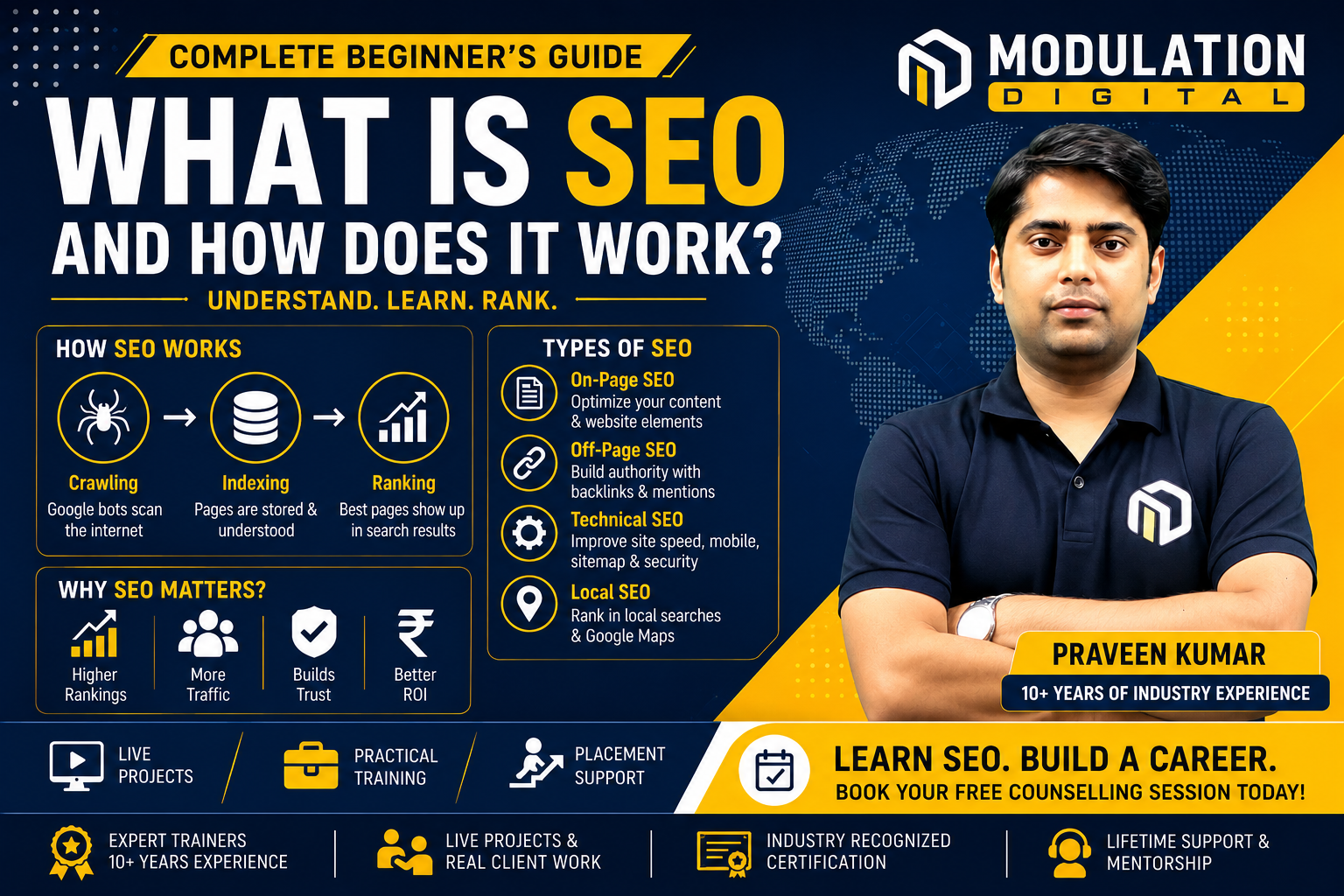
To understand what is SEO and how it works, you need to know the three basic stages Google goes through:
- Crawling — Google sends out automated bots (called "spiders") that scan the internet, discovering new and updated pages
- Indexing — Once a page is crawled, Google stores it in a massive database, understanding what the page is actually about
- Ranking — When someone searches a query, Google's algorithm decides which indexed pages best match that search, ranking them in order
Put simply, what is SEO and how it works comes down to making your website easy to crawl, clearly understood during indexing, and strong enough to rank well — using hundreds of ranking factors Google considers.
The Main Types of SEO
Any good Best digital marketing Institute in Delhi NCR will teach you that SEO isn't one single technique — it's a combination of different strategies working together:
- On-Page SEO — optimizing content and elements directly on your website
- Off-Page SEO — building credibility through links and mentions from other websites
- Technical SEO — improving the website's backend so search engines can crawl it properly
- Local SEO — optimizing for location-based searches, like "best cafe near me"
On-Page SEO Explained
On-page SEO focuses on everything within your control on your own website:
- Keyword usage — naturally including the words people actually search for
- Title tags and meta descriptions — the clickable text that appears in search results
- Content quality — writing that genuinely answers a searcher's question, not just stuffed with keywords
- Internal linking — connecting related pages on your own site to help both users and Google navigate it
Off-Page SEO Explained
Off-page SEO is about building trust and authority outside your own website:
- Backlinks — when other websites link back to yours, it signals to Google that your content is credible
- Domain authority — a general measure of how trustworthy your website appears based on its backlink profile
- Social signals and mentions — indirect trust signals from being talked about across the web
The key idea here is simple: the more genuine, relevant sites that vouch for you through links, the more Google trusts your content too.
Technical SEO Basics
This is the "behind the scenes" side of SEO that most beginners overlook, even though it often has a bigger impact than people expect:
- Site speed — slow-loading pages frustrate users and get penalized in rankings
- Mobile-friendliness — since most searches now happen on phones, mobile-optimized sites are essential
- XML sitemaps — a roadmap that helps search engines find and crawl all your pages efficiently
- Secure websites (HTTPS) — a basic trust signal search engines now expect by default
Common SEO Myths People Still Believe
A lot of outdated advice still floats around online, and even trainers at a less experienced Best digital marketing Institute in Delhi NCR sometimes repeat it. Let's clear up a few common misconceptions:
- "More keywords always means better ranking" — Not true. Overusing keywords (keyword stuffing) can actually hurt rankings today
- "SEO is a one-time task" — In reality, SEO requires ongoing effort since competitors and algorithms keep changing
- "Paid ads improve organic SEO rankings" — These are actually separate systems; running ads doesn't directly boost organic results
- "Only big businesses need SEO" — Local shops and small businesses often benefit the most from consistent, focused SEO work
How Long Does SEO Actually Take to Show Results?
This is one of the most commonly asked SEO questions, and the honest answer is: it depends, but rarely overnight. Most websites start seeing meaningful movement in rankings after 3 to 6 months of consistent effort, with stronger results typically building over 6 to 12 months. Anyone promising "SEO results in a week" is usually not being fully honest about how search engines actually work.
Is SEO Still Relevant in the Age of AI Search?
With AI-powered search experiences becoming more common, many people wonder if SEO is becoming outdated. The short answer is no — it's evolving, not disappearing. AI search tools still rely on crawling and understanding web content to generate their answers, which means well-optimized, genuinely helpful content remains just as important as before. If anything, content that clearly answers real questions (rather than thin, keyword-stuffed pages) is becoming even more valuable in this new search landscape, since AI systems tend to reward clarity and usefulness over sheer keyword density.
Can You Build a Career as an SEO Specialist?
Yes, and it's one of the more accessible entry points into the digital marketing field. Common career roles include SEO Executive, SEO Analyst, Content & SEO Strategist, and eventually SEO Manager or Consultant roles. Since SEO combines analytical thinking with writing and strategy, it suits people from a wide range of educational backgrounds, not just technical ones. Training at a structured Best digital marketing Institute in Delhi NCR can significantly speed up this learning curve compared to figuring it all out alone.
About Modulation Digital
Modulation Digital is a Best digital marketing Institute in Delhi NCR known for its practical, hands-on approach to teaching digital skills. Rather than focusing purely on theory, the institute is built around live projects, real client work, and structured mentorship — giving students a genuine feel for how SEO and digital marketing actually work inside a real business, not just inside a classroom. Over the years, it has become a trusted name for anyone serious about building a career in this field, largely because of its focus on outcomes rather than just certificates.
Meet Your Trainer – Praveen Kumar
Leading SEO and digital marketing training at this Best digital marketing Institute in Delhi NCR is Praveen Kumar, who brings over 10 years of industry experience to the classroom. His approach focuses on practical, project-based learning — walking students through real website audits and live SEO campaigns rather than relying only on slides and theory, so they graduate with skills they've actually practiced, not just memorized.
Learn SEO at Modulation Digital
As a Best digital marketing Institute in Delhi NCR, Modulation Digital offers SEO training as part of its broader digital marketing programs, covering:
- Keyword research and on-page optimization techniques
- Backlink building and off-page SEO strategies
- Technical SEO audits using real industry tools
- Local SEO for small and location-based businesses
Training is available through classroom sessions, live online classes, and recorded sessions with support, along with hands-on live projects and placement guidance for eligible students.
Frequently Asked Questions (FAQs)
1. What is SEO in the simplest terms? It's the practice of improving a website so it ranks higher in search engines like Google, without paying for advertising — this is exactly what a Best digital marketing Institute in Delhi NCR teaches from the ground up.
2. Do I need to know coding to learn SEO? No, basic SEO doesn't require coding knowledge, though understanding some technical SEO concepts becomes helpful as you advance.
3. What's the difference between SEO and SEM? SEO focuses on free, organic rankings, while SEM (Search Engine Marketing) typically refers to paid search advertising like Google Ads.
4. Can I do SEO for my own website without hiring anyone? Yes, many small business owners learn basic SEO themselves, though larger or more competitive websites often benefit from expert help.
5. What is the most important ranking factor in SEO? There's no single factor — Google considers hundreds of signals together, though content quality and backlinks remain among the most influential.
6. How is SEO different from digital marketing overall? SEO is one specific channel within digital marketing — other channels include social media marketing, paid ads, email marketing, and content marketing.
7. Is SEO a good career choice for beginners? Yes, it's considered one of the more beginner-friendly entry points into digital marketing, with strong long-term demand.
8. What tools are commonly used for SEO? Popular tools include Google Search Console, Google Analytics, Ahrefs, SEMrush, and Google Keyword Planner.
9. Can small businesses really benefit from SEO? Absolutely — local SEO in particular helps small businesses appear in nearby searches like "shop near me," often with less competition than larger keywords.
10. Why did my website's ranking suddenly drop? This usually happens due to algorithm updates, technical issues, lost backlinks, or increased competition — regular monitoring helps catch these early.
11. Is it possible to learn SEO for free online? Yes, many basics can be learned through free resources, though structured, hands-on training helps avoid common beginner mistakes faster.
12. Do backlinks still matter in 2026? Yes, backlinks remain a strong trust signal, though quality and relevance now matter far more than sheer quantity.
13. What is keyword stuffing, and why is it bad? It means overusing a keyword unnaturally throughout content — search engines now penalize this instead of rewarding it.
14. Does using AI-generated content on my website hurt my SEO rankings? Not automatically — Google doesn't penalize content just for being AI-assisted. What actually matters is whether the content is genuinely helpful, accurate, and well-edited. Thin, generic AI content without real value tends to underperform, regardless of who or what wrote it.
15. I keep hearing about data and analytics alongside marketing — how are they connected? SEO and digital marketing rely heavily on data — tracking rankings, traffic, and user behavior to make better decisions. If you're curious about how data itself is analyzed and used to predict outcomes, that's covered in depth in our other guide: [What is Data Science? A Beginner's Guide — insert Day 3 blog link here]
Conclusion
By now, the answer to what is SEO and how it works should feel much clearer — it's a mix of technical structure, quality content, and genuine credibility, all working together to help search engines trust and rank a website. It's not a one-time trick but an ongoing skill that keeps evolving alongside search technology itself. Understanding what is SEO and how it works is just the starting point — applying it consistently is what actually moves the needle for a website. If you're looking to learn this properly, Modulation Digital, a trusted Best digital marketing Institute in Delhi NCR, offers hands-on SEO training under the guidance of Praveen Kumar, helping students build real, practical skills rather than just theory. Reach out today to book a free counselling session.