Why Java for Full Stack Development?
Java's popularity in enterprise environments isn't accidental — it's built on decades of proven stability. A few reasons stand out:
| Reason | Why It Matters |
| Platform independence | Java runs on any device with a JVM, thanks to "write once, run anywhere" |
| Strong backward compatibility | Older Java code continues to work reliably even as the language evolves |
| Robust security features | Built-in security makes it a preferred choice for banking and enterprise systems |
| Massive enterprise adoption | Countless large companies already run on Java, keeping demand for skilled developers high |
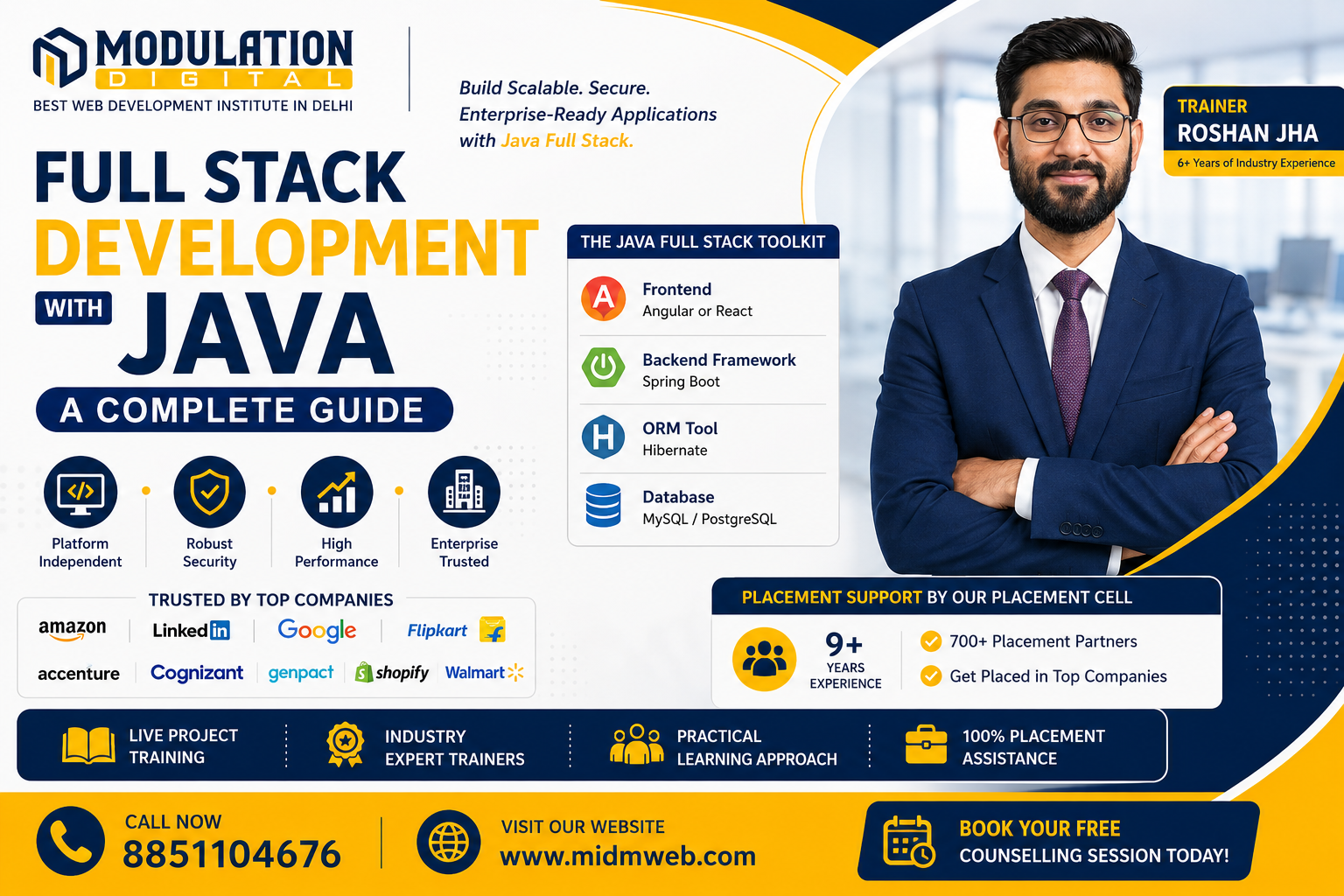
The Java Full Stack Toolkit
A typical Java full stack setup includes the following layers:
| Layer | Technology | Role |
| Frontend | Angular or React | Builds the interactive user interface |
| Backend Framework | Spring Boot | Simplifies building APIs and business logic |
| ORM Tool | Hibernate | Connects Java code with the database without writing raw SQL constantly |
| Database | MySQL or PostgreSQL | Stores and manages application data |
Understanding the Spring Boot Framework
Spring Boot is the backbone of most modern Java backend development. It simplifies what used to be a complicated setup process into something much more manageable:
- Auto-configuration — reduces the manual setup traditionally required for Java web applications
- Built-in server support — applications can run without needing a separately configured external server
- Strong ecosystem — handles everything from security to database connections through well-supported modules
- Widely used in production — making it a genuinely practical skill rather than just an academic exercise
Java Full Stack Architecture — How the Layers Connect
Understanding how data actually flows through a Java full stack application helps make the bigger picture click:
- User interacts with the frontend — built using Angular or React
- Frontend sends a request — typically through an API call to the backend
- Spring Boot processes the request — applying business logic and validation
- Hibernate communicates with the database — retrieving or updating the required data
- Response travels back — from the database, through Spring Boot, back to the frontend for display
Java vs Node.js for Full Stack Development
Both are popular full stack choices, but they suit different needs:
| Factor | Java Full Stack | Node.js Full Stack |
| Best For | Large, complex enterprise applications | Fast-moving startups, real-time apps |
| Performance Style | Strong for heavy, structured processing | Excellent for handling many simultaneous requests |
| Learning Curve | Steeper, more structured | Generally faster to pick up, especially with JavaScript background |
| Long-Term Stability | Extremely stable, decades of enterprise use | Newer, but rapidly maturing ecosystem |
Neither is universally "better" — the right choice depends on the scale, purpose, and long-term maintenance needs of the project. Many companies actually use both, choosing Java for core enterprise systems and Node.js for faster-moving customer-facing features.
Which Companies Rely on Java for Large-Scale Systems?
Java isn't just a classroom language — major companies still depend on it heavily:
- Amazon — uses Java extensively across its backend infrastructure
- LinkedIn — relies on Java for large portions of its platform architecture
- Banking and financial institutions — commonly choose Java for its security and reliability at scale
- Google — uses Java internally for various large-scale systems alongside other languages
Common Interview Questions for Java Full Stack Developers
If you're preparing for a Java full stack role, these commonly come up:
- What is the difference between JDK, JRE, and JVM?
- How does Spring Boot simplify Java web development?
- What is dependency injection, and why does Spring use it?
- How does Hibernate handle database relationships?
- What are RESTful APIs, and how do you build one using Spring Boot?
Being able to answer these with real project context, not just textbook definitions, makes a much stronger impression in interviews — interviewers can usually tell the difference between memorized answers and genuine understanding.
About Modulation Digital
Modulation Digital is a Best Web Development Institute in Delhi focused on practical, project-based learning. Students build real Java full stack applications during training, working directly with Spring Boot and Hibernate rather than just studying theory.
Meet Your Trainer – Roshan Jha
Leading full stack development training at this Best Web Development Institute in Delhi is Roshan Jha, who brings over 6 years of industry experience across multiple full stack technologies, including Java. His teaching approach focuses on building real, working applications step by step, helping students understand how each layer of the architecture actually connects rather than memorizing isolated concepts.
Placement Support by Our Placement Cell
Learning to build applications is only half the journey — actually getting placed in a genuine, reputed company is what matters most. This is handled by Prem, our Placement Cell (9+ years of industry experience), who works directly with hiring partners to connect students with real job opportunities once their training is complete.
Students from Modulation Digital have gone on to join well-known companies, including:
Accenture  | Amazon  | Cognizant  | Genpact 
| Flipkart 
|
eBay  | Shopify  | Walmart  | TATA Capital  | Snapdeal  |
These are just a few names from our wider network of 700+ placement partners — genuine hiring companies that have actually recruited students from our courses, not just names listed for show.
Frequently Asked Questions (FAQs)
1. Is Java hard to learn for complete beginners? It has a steeper learning curve than some languages, but structured guidance and consistent practice make it manageable even for beginners.
2. Do I need to learn Spring Boot separately from core Java? Yes, Spring Boot builds on core Java knowledge, so a solid foundation in Java basics makes learning it much smoother.
3. Is Java still relevant in 2026, or is it outdated? Very relevant — many large enterprises continue building and maintaining systems on Java, keeping consistent demand for skilled developers.
4. What is Hibernate, and why is it used with Java? Hibernate is a tool that lets Java applications interact with databases without writing extensive raw SQL code manually.
5. Can I use React instead of Angular with a Java backend? Yes, React works perfectly well with a Java Spring Boot backend — the choice mostly comes down to personal or team preference.
6. How long does it take to become job-ready in this stack? With consistent effort, most beginners can become job-ready within 6 to 8 months, depending on prior programming experience.
7. Is Java full stack development in demand in India? Yes, particularly in banking, finance, and large enterprise sectors that continue to rely heavily on Java-based systems.
8. What is the difference between JDK and JVM? JDK is the full development kit used to build Java applications, while JVM is the runtime environment that actually executes the compiled code.
9. Do I need to know SQL if I'm using Hibernate? Basic SQL knowledge still helps, even though Hibernate reduces how much raw SQL you need to write directly.
10. Are Java full stack developers paid well compared to other stacks? Generally yes, especially in enterprise and banking sectors where Java skills remain consistently in demand.
11. Can I switch from Java to another full stack language later? Yes, core programming concepts transfer well, making it easier to pick up other languages once Java fundamentals are strong.
12. What kind of projects are best for practicing Java full stack skills? Simple applications like a task manager, an inventory system, or a basic e-commerce backend are great starting points.
13. Is Java full stack development suitable for startups too? It can be, though startups often prefer lighter, faster-to-build stacks, while Java shines more in larger, long-term systems.
14. Do I need a strong math background to learn Java development? No, most full stack Java development relies more on logical thinking and structured problem-solving than advanced mathematics.
15. Once I've built a Java application, how do I actually promote it or drive traffic to it if it's a business website? That's where paid advertising becomes useful for quick visibility. It's covered in detail in our other guide: How to Run Google Ads: A Beginner's Guide
Conclusion
Full stack development with java continues to be one of the most reliable, enterprise-trusted skill combinations in web development, backed by decades of real-world use and strong long-term demand. Whether you're aiming for a large corporate role or want a genuinely stable long-term career path, Java full stack skills remain a solid investment. If you're ready to start learning, Modulation Digital, a trusted Best Web Development Institute in Delhi, offers hands-on training under Roshan Jha's guidance, helping students build real, working applications from the ground up. Reach out today to book a free counselling session.