What is SQL and Why Does It Matter for Data Science?
SQL, or Structured Query Language, is the standard language used to communicate with databases — retrieving, updating, and organizing data stored in structured tables. For anyone working with data, SQL is often the very first step before any analysis or modeling even begins, since most business data lives inside databases that only SQL can efficiently query.
Core SQL Concepts Every Beginner Should Know
Before diving into commands, it helps to understand a few foundational ideas:
| Concept | What It Means |
| Table | A structured collection of data organized into rows and columns |
| Row | A single record within a table, like one customer or one transaction |
| Column | A specific attribute of the data, like "name" or "date" |
| Query | A request written in SQL to retrieve or manipulate data |
| Primary Key | A unique identifier for each row in a table |
Essential SQL Commands to Start With
A small set of commands covers the majority of what beginners need early on:
| Command | Purpose |
| SELECT | Retrieves specific columns of data from a table |
| WHERE | Filters results based on a specific condition |
| JOIN | Combines data from two or more related tables |
| GROUP BY | Groups rows sharing a value, often paired with functions like COUNT or SUM |
| ORDER BY | Sorts query results in ascending or descending order |
Step-by-Step Learning Path for SQL Beginners
Here's a realistic sequence for learning SQL from scratch:
- Understand database basics — learn what tables, rows, and columns actually represent
- Master SELECT and WHERE — the two commands you'll use constantly from day one
- Practice filtering and sorting data — build comfort with narrowing down large datasets
- Learn JOINs — this is usually where beginners struggle most, so extra practice helps
- Explore aggregate functions — COUNT, SUM, AVG, and GROUP BY for summarizing data
- Work with real datasets — apply everything on actual sample databases, not just isolated exercises
- Build small projects — write queries to answer specific business-style questions
A Simple SQL Query Example Walkthrough
Imagine you have a table called sales with columns for region, product, and amount. Here's how a basic analysis might look:
- See all records — SELECT * FROM sales; pulls every row from the table
- Filter by region — SELECT * FROM sales WHERE region = 'Delhi'; narrows results to just Delhi
- Calculate total sales — SELECT SUM(amount) FROM sales; adds up the entire amount column
- Group by product — SELECT product, SUM(amount) FROM sales GROUP BY product; shows total sales per product
Once these individual pieces feel familiar, combining them into more complex queries becomes much more manageable.
SQL vs NoSQL — A Quick Clarification
Beginners often wonder how SQL compares to NoSQL databases like MongoDB:
| Aspect | SQL | NoSQL |
| Data Structure | Structured tables with fixed schemas | Flexible, often JSON-like documents |
| Best For | Data with clear relationships, like financial records | Rapidly changing or unstructured data |
| Query Language | Standardized SQL syntax | Varies by database system |
| Common Use Cases | Banking, enterprise systems, reporting | Content management, real-time apps |
Most data analysis and business reporting still relies heavily on SQL, making it the more essential starting point for beginners.
Common SQL Mistakes Beginners Make
| Mistake | Why It's a Problem |
| Forgetting the WHERE clause | Can accidentally update or delete every row in a table |
| Confusing JOIN types | Using the wrong JOIN can return incomplete or duplicated results |
| Not testing queries on small data first | Running untested queries on large datasets can be risky and slow |
| Ignoring query performance | Poorly written queries can run painfully slow on large tables |
Best Free Resources and Practice Platforms for SQL
You don't need paid courses to start practicing:
- SQLZoo — interactive, beginner-friendly practice exercises
- Mode SQL Tutorial — free, structured lessons with real business-style examples
- Kaggle Datasets — practice writing queries against real, publicly available data
- W3Schools SQL — a solid quick-reference for syntax while learning
About Modulation Digital
Modulation Digital is a Best Data Science Institute in Delhi built around practical, hands-on learning. Students practice SQL directly on real datasets throughout their training, moving well beyond isolated textbook exercises.
Meet Your Trainers
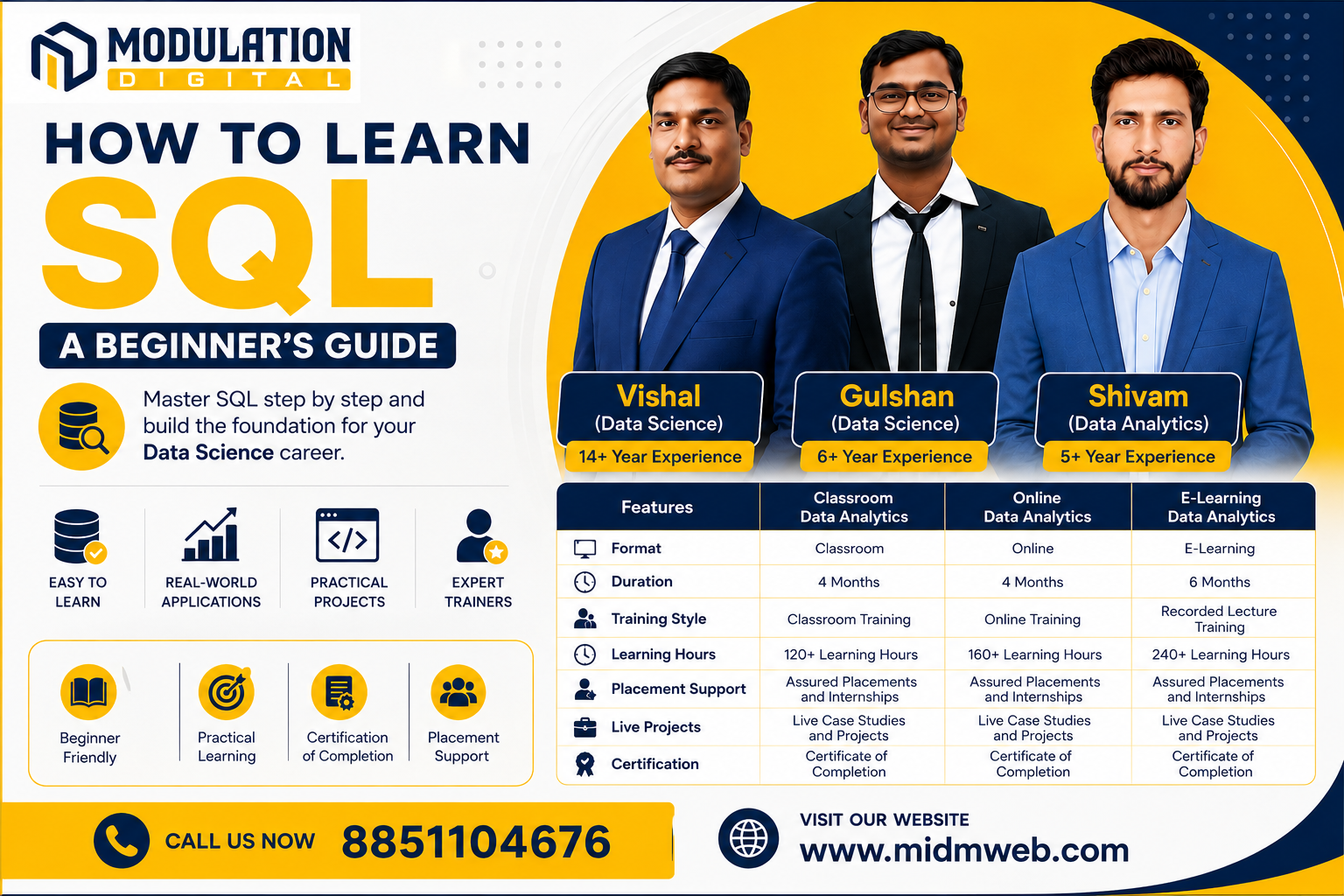
Learning SQL and data skills at Modulation Digital means training under three specialists:
| Trainer | Specialization | Experience |
| Shivam | Data Analytics | 5+ years |
| Vishal | Data Science | 14+ years |
| Gulshan | Data Science | 6+ years |
Shivam leads SQL training as part of the core analytics curriculum, helping students apply it directly to real business reporting scenarios.
Vishal, with over a decade of industry experience, shows students how SQL connects to larger data science workflows, including preparing data for machine learning models.
Gulshan works alongside Vishal, helping students strengthen their query-writing skills through guided, hands-on practice on real datasets.
Course Options at Modulation Digital
Modulation Digital offers three flexible ways to learn data analytics and data science, all covering the same core outcomes:
| Classroom Data Analytics | Online Data Analytics | E-Learning Data Analytics | |
| Format | Classroom | Online | E-Learning |
| Duration | 4 Months | 4 Months | 6 Months |
| Training Style | Classroom Training | Online Training | Recorded Lecture Training |
| Learning Hours | 120+ Learning Hours | 160+ Learning Hours | 240+ Learning Hours |
| Placement Support | Assured Placements and Internships | Assured Placements and Internships | Assured Placements and Internships |
| Live Projects | Live Case Studies and Projects | Live Case Studies and Projects | Live Case Studies and Projects |
| Certification | Certificate of Completion | Certificate of Completion | Certificate of Completion |
Whether you prefer in-person classroom training, live online sessions, or fully recorded lectures you can watch anytime, all three formats include the same hands-on project work and placement support — just delivered in a way that fits your schedule.
Placement Support by Our Placement Cell
Learning technical skills is only half the journey — actually getting placed in a genuine, reputed company is what matters most. This is handled by Prem, our Placement Cell (9+ years of industry experience), who works directly with hiring partners to connect students with real job opportunities once their training is complete.
Students from Modulation Digital have gone on to join well-known companies, including:
Snapdeal  | TATA Capital  | Walmart  | Shopify  | eBay  |
Flipkart  | Genpact  | Cognizant  | Amazon  | Accenture  |
These are just a few names from our wider network of 700+ placement partners — genuine hiring companies that have actually recruited students from our courses, not just names listed for show.
Frequently Asked Questions (FAQs)
1. Is SQL hard to learn for complete beginners? No, SQL is considered one of the more beginner-friendly languages, since its syntax closely resembles plain English instructions.
2. Do I need to know programming before learning SQL? Not necessarily — many people learn SQL as their very first technical skill without prior coding experience.
3. How long does it take to learn SQL basics? Most beginners can learn core SQL commands within 2 to 4 weeks of consistent, focused practice.
4. Is SQL still relevant given the rise of AI tools? Yes, AI tools still rely on structured data, and understanding SQL helps you verify, question, and work with that data effectively.
5. What's the difference between SQL and MySQL? SQL is the language itself, while MySQL is one specific database system that uses SQL to manage data.
6. Can I learn SQL without installing any software? Yes, many free online platforms let you practice SQL directly in the browser without any local installation.
7. Is SQL only used by data analysts and scientists? No, backend developers, business analysts, and even marketers commonly use SQL to work with data in their roles.
8. What is a JOIN, and why is it confusing for beginners? A JOIN combines data from multiple tables, and it's confusing mainly because there are several types, each behaving slightly differently.
9. Do I need to memorize every SQL command to be good at it? No, most professionals regularly reference documentation — understanding core logic matters more than memorizing every command.
10. Can SQL handle very large datasets? Yes, SQL databases are specifically designed to handle large volumes of structured data efficiently.
11. What's a good first project to practice SQL? Working with a sample sales or customer dataset to answer specific business questions is a great, practical starting point.
12. Is SQL used the same way across all databases? Mostly yes, though different database systems have minor syntax variations worth knowing once you're comfortable with the basics.
13. Can learning SQL help me transition into data science later? Yes, SQL is often the first practical skill that leads naturally into broader data analytics and data science learning paths.
14. Do employers actually test SQL skills in interviews? Yes, SQL is one of the most commonly tested skills in data-related job interviews, often through live query-writing exercises.
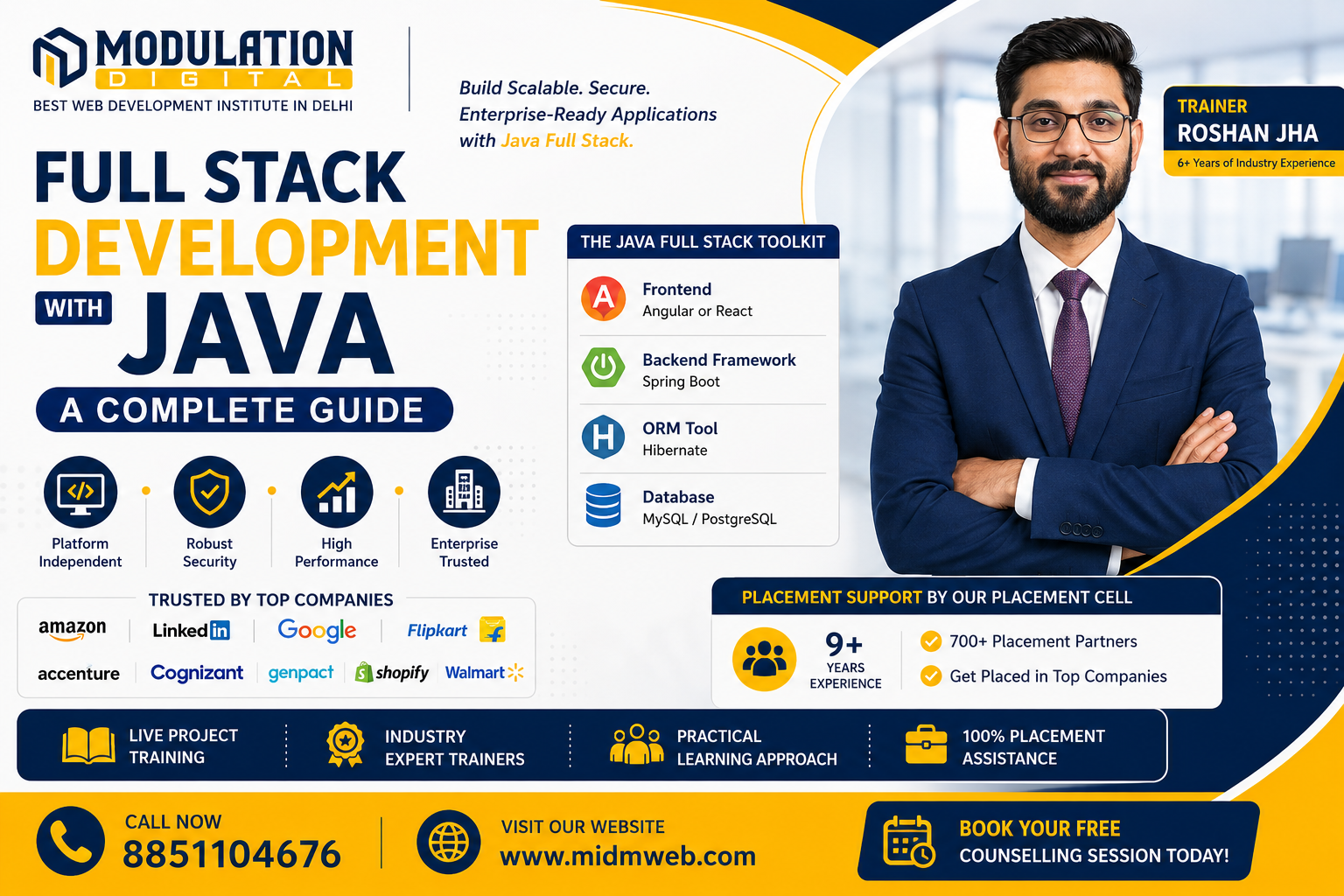
15. Once I know SQL, how do I use a full programming language to build more advanced systems around that data? That's where a broader tech stack comes in, including backend frameworks like Java. It's covered in detail in our other guide:Full Stack Development with Java: A Complete Guide
Conclusion
Learning how to learn sql effectively comes down to starting with the fundamentals, practicing consistently on real data, and gradually building up to more complex queries rather than trying to memorize everything at once. It's a skill that pays off across nearly every data-related career path. If you're ready to learn this properly, Modulation Digital, a trusted Best Data Science Institute in Delhi, offers structured training under experienced mentors across both data analytics and data science. Reach out today to book a free counselling session.