
What Are Docker and Kubernetes?
Imagine developing a website that works perfectly on your laptop but suddenly stops working when deployed to a server. Different software versions, missing dependencies, and configuration errors can create unexpected problems.
Docker and Kubernetes help developers package, deploy, and manage applications more consistently across different computing environments.
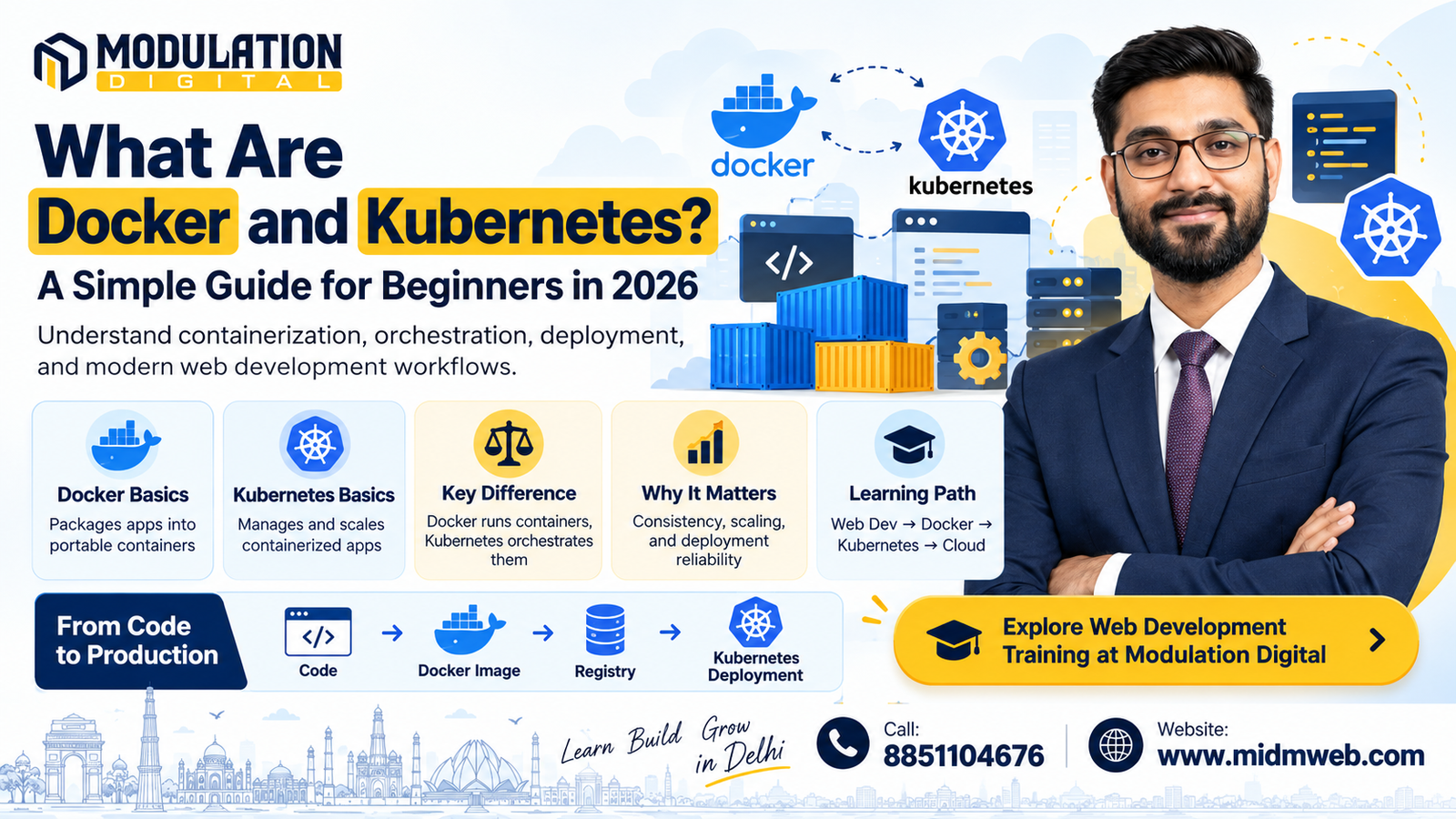
If you are wondering what are Docker and Kubernetes, the simplest explanation is that Docker creates and runs containers, while Kubernetes manages containerized applications across servers.
These technologies have become important in modern web development, DevOps, and cloud computing.
Students exploring the Best Web Development Institute in Delhi NCR can benefit from understanding these tools alongside frontend programming, backend development, and application deployment.
1. What Is Docker and Why Is It Used?
Docker is an open-source containerization platform that allows developers to package applications and their dependencies into portable, isolated environments called containers.
A container includes the application and the necessary software components required to run it.
For example, imagine two developers working on the same Node.js project. One uses a newer Node.js version, while the other uses an older version.
Their applications may behave differently because their development environments are not identical.
Docker reduces this problem by allowing developers to run the application using a consistent container image.
According to the official Docker documentation, Docker supports developing, testing, distributing, and running applications through standardized environments.
This makes Docker useful for team collaboration, software testing, and application deployment.
2. What Is Kubernetes and How Does It Work?
Kubernetes, commonly called K8s, is an open-source container orchestration platform that automates the deployment, scaling, and management of containerized applications.
While Docker helps developers create and run containers, Kubernetes manages application workloads across multiple machines.
Consider an online shopping website experiencing unusually high traffic during a sale.
A single application instance may struggle to handle thousands of simultaneous requests.
Kubernetes can coordinate multiple application instances and distribute incoming traffic through properly configured services.
It also monitors application workloads and can replace failed Pods automatically.
According to the Kubernetes documentation, Kubernetes supports declarative configuration and automation for containerized workloads.
This makes it useful for applications that require scalable and reliable infrastructure.
3. What Is the Difference Between Docker and Kubernetes?
The main difference between Docker and Kubernetes is their responsibility: Docker packages and runs containers, while Kubernetes orchestrates containerized applications across infrastructure.
These technologies solve different problems and can work together.
| Feature | Docker | Kubernetes |
| Main purpose | Containerization | Container orchestration |
| Primary function | Builds and runs containers | Deploys and manages workloads |
| Application scaling | Supports container scaling through additional tooling | Supports automated workload scaling |
| Networking | Provides container networking | Manages networking through Pods and Services |
| Deployment | Runs containerized applications | Coordinates complex deployments |
| Recovery | Supports restart policies | Replaces unhealthy Pods |
| Learning level | Beginner-friendly fundamentals | More advanced infrastructure concepts |
| Common use | Development and application packaging | Cluster and application management |
Docker is generally easier to learn initially because it introduces the fundamentals of containerization.
Kubernetes requires additional knowledge of networking, infrastructure, and distributed application management.
An important technical distinction is that Kubernetes does not require Docker Engine to run containers. It supports compatible container runtimes such as containerd.
4. How Does Docker Containerization Work?
Docker containerization works by packaging application code, runtime dependencies, and configuration into an image that can be used to create containers.
A Docker image is a reusable template containing instructions for running an application.
A container is a running instance of that image.
Consider a web application developed using React, Node.js, and PostgreSQL.
Instead of installing every component directly on each developer's computer, the team can use separate containers for the frontend, backend, and database.
Docker Compose can coordinate these services through a configuration file.
This approach simplifies development environment setup and helps teams work with more consistent configurations.
However, developers must still manage networking, persistent data, environment variables, and application security correctly.
Docker improves consistency but does not eliminate every deployment challenge.
5. How Do Docker and Kubernetes Work Together?
Docker can build container images, while Kubernetes can deploy and manage workloads created from those images.
Imagine a food delivery platform containing customer accounts, restaurant listings, payment processing, and order tracking.
Developers can package different application services into container images.
These images are uploaded to a container registry, where they become available for deployment.
Kubernetes can then retrieve the images and coordinate the application workloads across a cluster.
A typical workflow follows this sequence:
Application Code → Docker Image → Container Registry → Kubernetes Deployment → Running Application
If application traffic increases, Kubernetes can scale configured workloads when sufficient infrastructure resources are available.
If a Pod fails, Kubernetes controllers can create a replacement to maintain the desired number of running instances.
This combination supports consistent deployment and infrastructure automation.
6. Why Are Docker and Kubernetes Important for Web Developers?
Docker and Kubernetes help web developers understand modern application deployment, environment consistency, scalability, and infrastructure management.
Today, many websites rely on multiple interconnected services rather than a single application.
A modern e-commerce platform may contain a frontend interface, backend APIs, authentication services, payment integrations, and databases.
Docker allows teams to package application components consistently.
Kubernetes helps manage these components when infrastructure requirements become more complex.
These technologies also connect with continuous integration and continuous delivery, commonly called CI/CD.
However, not every website requires Kubernetes.
A small business website or simple portfolio may operate efficiently using conventional hosting.
Developers should select deployment technologies according to actual application requirements rather than industry popularity.
7. What Should Beginners Learn Before Docker and Kubernetes?
Beginners should understand programming fundamentals, web development, Linux commands, networking, and Git before progressing toward container orchestration.
A useful learning journey begins with HTML, CSS, JavaScript, and a backend technology such as Node.js.
Next, students should understand how web servers, databases, APIs, and application environments interact.
After developing these fundamentals, Docker becomes easier to understand.
Students can learn about images, containers, Dockerfiles, storage volumes, and networking.
Kubernetes concepts such as Pods, Deployments, Services, and cluster architecture can follow.
Students searching for the Best Web Development Institute in Delhi NCR should compare training programs that combine programming fundamentals with practical application development.
Learning deployment concepts alongside real projects can provide a more complete understanding of software development.
8. Can Beginners Build Projects Using Docker and Kubernetes?
Yes. Beginners can build a simple web application, package it with Docker, and deploy it to a local Kubernetes environment.
Consider creating a task management application.
The frontend allows users to add, update, and delete tasks.
A backend API processes requests and stores information in a database.
Start by running the application locally.
Next, create Docker images for the application components and use Docker Compose to manage their development environment.
After testing the containerized application, experiment with a local Kubernetes cluster using tools such as Minikube or kind.
Students can explore Pods, Services, deployment updates, and scaling behavior.
A project like this demonstrates practical knowledge of application development and deployment.
It can also become a useful portfolio example when supported by clear documentation.
9. Are Docker and Kubernetes Necessary for Every Developer?
Docker is useful for many backend and full-stack developers, but Kubernetes is not essential for every development project or job role.
Frontend developers creating static websites may rarely need container orchestration.
Backend developers can benefit from Docker when working with application dependencies, databases, and testing environments.
Kubernetes becomes more relevant when applications require multiple services, distributed infrastructure, and automated workload management.
For example, a simple website may only require static hosting and a content management system.
A large application serving users across multiple regions may require more sophisticated infrastructure.
Understanding both technologies helps developers communicate with DevOps engineers and make informed deployment decisions.
The goal should be to learn when each technology solves a real problem.
10. Why Consider Modulation Digital for Web Development Training in Delhi NCR?
Students searching for the Best Web Development Institute in Delhi NCR can consider Modulation Digital when comparing web development training opportunities.
Modern web development requires knowledge of frontend technologies, backend programming, databases, APIs, and application deployment.
Students should compare course syllabi, trainer experience, learning methods, and practical project opportunities before selecting an institute.
Modulation Digital, located in Laxmi Nagar, Delhi, is an option for prospective learners exploring web development education.
Students interested in Docker, Kubernetes, and DevOps should confirm whether these technologies are included in the institute's current curriculum.
Choosing a course that connects programming concepts with practical projects can help learners understand how real applications are developed.
Modulation Digital – Contact Information
Address: D-126, Gali No. 6, Near Laxmi Nagar Metro Station, Gate No. 5, Laxmi Nagar, Delhi – 110092
Phone: +91 8851104676
Website: www.midmweb.com
FAQs
1. What Are Docker and Kubernetes in Simple Words?
Docker packages applications and dependencies into portable containers, while Kubernetes automates the deployment, scaling, and management of containerized applications across servers.
2. What Is the Main Difference Between Docker and Kubernetes?
Docker focuses on building and running containers. Kubernetes coordinates containerized workloads, manages application instances, and supports automated scaling and recovery.
3. Should Beginners Learn Docker or Kubernetes First?
Beginners should generally learn Docker first. Understanding containers, images, networking, and Dockerfiles provides a useful foundation before exploring Kubernetes clusters and orchestration.
4. Can Kubernetes Run Without Docker?
Yes. Kubernetes does not require Docker Engine. It uses compatible container runtimes such as containerd or CRI-O to run containerized workloads.
5. Are Docker and Kubernetes Useful for Full-Stack Developers?
Yes. Docker helps full-stack developers manage application environments, while Kubernetes is useful when working with complex deployments and scalable backend systems.
6. Is Kubernetes Difficult for Beginners?
Kubernetes can initially seem complicated because it involves networking, infrastructure, configuration, and orchestration. Learning Docker and basic deployment concepts first can make it easier.
7. Which Is the Best Web Development Institute in Delhi NCR?
Students comparing the Best Web Development Institute in Delhi NCR can explore Modulation Digital and evaluate its current curriculum, practical projects, trainer guidance, and deployment-related learning opportunities before enrolling.
8. What Is the Future Scope of Docker and Kubernetes?
Docker and Kubernetes remain relevant for cloud-native applications, containerized deployments, DevOps, and infrastructure automation. These skills can support careers in backend development, cloud engineering, and platform operations.
Conclusion
Understanding what are Docker and Kubernetes helps beginners recognize how modern applications move from development environments to live servers.
Docker simplifies application packaging by creating portable containers, while Kubernetes helps manage containerized workloads across infrastructure.
Together, they support modern software development practices, particularly when applications require consistent deployment environments and scalable infrastructure.
For students interested in expanding their technical knowledge, learning Docker and Kubernetes alongside frontend development, backend programming, databases, and cloud fundamentals can provide a stronger foundation.
If you are exploring the Best Web Development Institute in Delhi NCR, consider reviewing the web development training opportunities at Modulation Digital, Laxmi Nagar, Delhi.
Contact +91 8851104676 or visit www.midmweb.com to enquire about available courses, training modules, batch schedules, and enrollment details.