
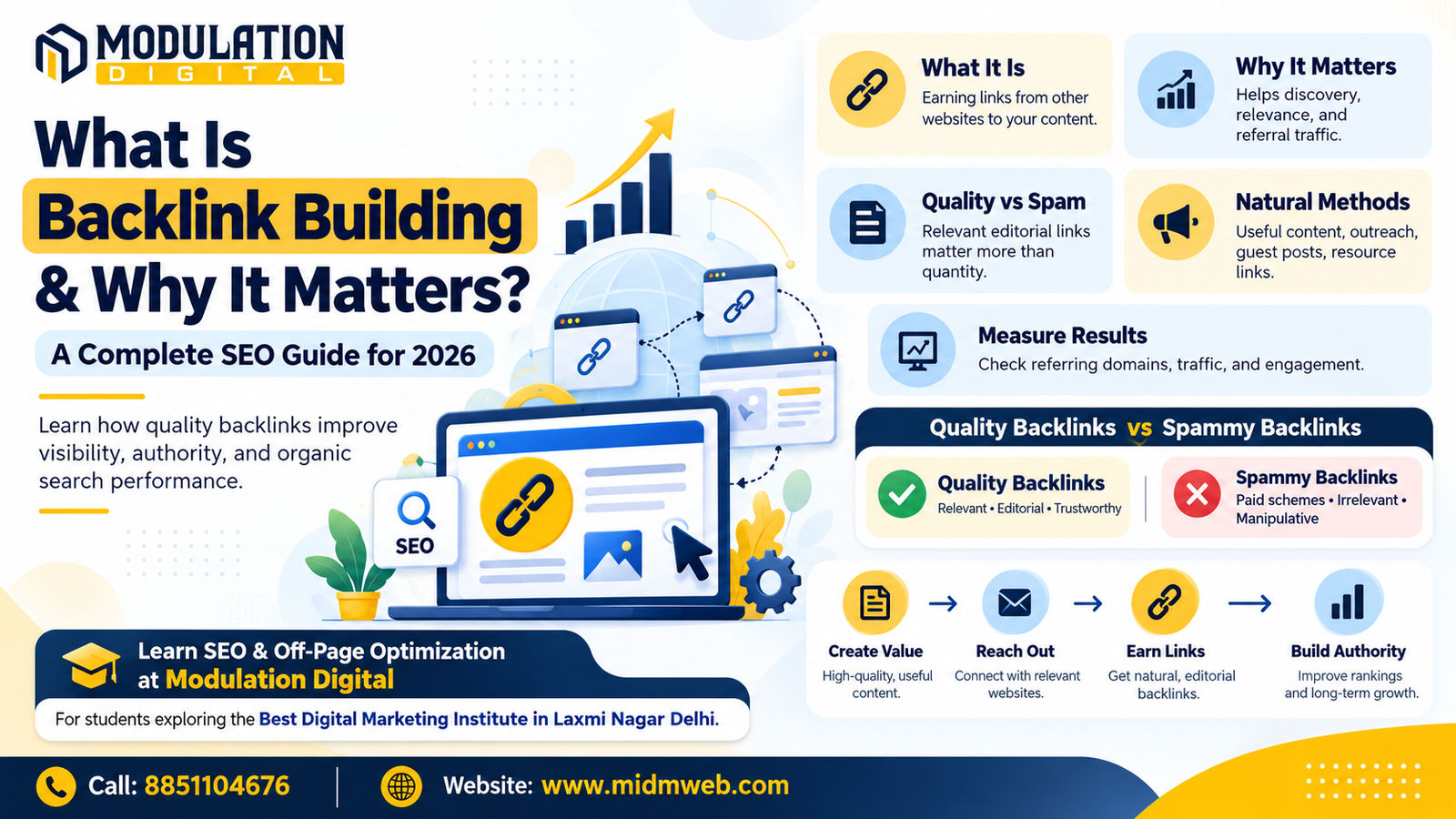
What Is Backlink Building and Why It Matters?
Imagine publishing an informative article on your website but receiving very little organic traffic. Your content may be helpful and technically optimized, yet other websites still appear above yours in Google results.
One possible difference is the quality and relevance of websites linking to those competing pages.
Backlink building is the process of earning links from other websites to your own website to improve discoverability, establish relevance, and support search engine optimization.
Understanding what is backlink building is important for anyone learning SEO, content marketing, or website promotion.
Backlinks are not simply links placed across the internet. Their context, relevance, and editorial value matter.
For students exploring the Best Digital Marketing Institute in Laxmi Nagar Delhi, learning ethical link building alongside on-page SEO and technical SEO can help develop a more complete understanding of organic search marketing.
What Is Backlink Building in SEO?
Backlink building is an off-page SEO activity focused on earning relevant hyperlinks from external websites that direct users to your content.
A backlink is created when one website links to a page on another website.
For example, suppose a technology blog publishes an article explaining SEO tools and links to your detailed keyword research guide.
That hyperlink becomes a backlink to your website.
Backlinks can help people discover useful resources and provide search engines with context about connections between webpages.
According to Google Search Central, Google uses links to discover pages and as one signal when evaluating their relevance.
However, not every backlink contributes equally.
A relevant editorial reference from a credible website is generally more meaningful than a link placed on an unrelated, low-quality page.
Why Are Backlinks Important for Google SEO?
Backlinks matter because they can help search engines discover webpages, understand relationships between content, and evaluate relevance within the broader web.
When a respected publication links to a useful resource, readers gain another route to discovering that information.
For example, a business publication might reference an original report explaining digital marketing trends.
Visitors reading that publication can follow the link to explore the complete research.
Relevant backlinks may also bring referral traffic independent of Google rankings.
How Backlinks Support Organic Visibility
Backlinks can contribute to discovery, referral visits, and a website's broader online reputation.
However, they are only one part of SEO.
Google also considers many other factors, including content relevance, usability, and search intent.
A website with numerous backlinks is not automatically more valuable than a website with fewer links.
Building useful content and earning genuine references is more sustainable than focusing solely on backlink quantity.
What Are the Different Types of Backlinks?
Backlinks can be categorized according to how they are created, their purpose, and the link attributes that help search engines interpret them.
Understanding these differences helps beginners evaluate links more accurately.
Types of Backlinks in SEO
| Backlink Type | Meaning | Common Example |
| Editorial backlink | Naturally given as a useful reference | A publication citing original research |
| Guest contribution link | Included in relevant contributed content | Author linking to a supporting resource |
| Resource-page backlink | Listed among useful references | Educational resource collection |
| Business citation link | Appears on a legitimate business listing | Relevant local directory |
| Sponsored link | Associated with advertising or compensation | Paid promotional article |
| User-generated link | Created through user-submitted content | Forum discussion or comment |
Links can also contain attributes such as nofollow, sponsored, or ugc.
These attributes provide Google with additional information about the nature of a link.
A sponsored link, for example, should be appropriately qualified rather than used to manipulate search rankings.
The most useful backlinks are generally those that provide genuine value to readers.
What Is the Difference Between Quality and Spammy Backlinks?
Quality backlinks appear naturally within relevant, useful content, while spammy backlinks are primarily created to manipulate search rankings.
Consider a digital marketing website receiving a link from a reputable educational publication discussing SEO research.
That link provides context and may help interested readers discover the referenced content.
Now imagine the same website purchasing hundreds of links from unrelated pages containing repetitive promotional anchor text.
Those links offer little value to users and may violate search engine policies.
How to Identify a Relevant Backlink
Evaluate the linking website's subject, content quality, audience relevance, and reason for referencing your page.
Ask whether the link would still make sense if search engines did not exist.
If the answer is yes, it is more likely to serve a genuine editorial purpose.
Google's spam policies identify manipulative link purchases, excessive exchanges, and automated link creation as examples of link spam.
Building links should therefore focus on useful relationships rather than artificial ranking signals.
How Can Beginners Build Backlinks Naturally?
Beginners can earn backlinks by creating useful resources, identifying relevant outreach opportunities, and contributing genuinely valuable information to their industry.
The first step is developing content that other websites have a reason to reference.
This may include original research, practical tutorials, informative comparisons, or carefully documented examples.
For instance, a digital marketing website could publish a detailed guide showing how to identify technical SEO problems.
Website owners writing about technical optimization may find that guide useful for their audiences.
A Practical Backlink Building Process
Start by selecting a valuable page on your website.
Identify relevant publications or websites whose readers may benefit from its information.
Review their existing content and determine whether your resource adds something new.
Contact the appropriate editor with a personalized explanation of why your resource could be useful.
Avoid demanding links or sending identical promotional messages to hundreds of websites.
Effective outreach focuses on relevance, useful information, and professional communication.
How Does Guest Blogging Help With Link Building?
Guest blogging can build industry visibility and relevant referral traffic when articles are created primarily to provide value to another publication's audience.
For example, an experienced SEO professional may contribute an article explaining common website indexing problems to a relevant marketing publication.
The article should contain original information, accurate explanations, and practical examples.
A contextual reference may be appropriate when it genuinely supports the subject.
However, publishing large numbers of low-quality guest posts solely to obtain keyword-rich links can become manipulative.
Google specifically warns against large-scale article campaigns designed to create ranking signals.
A useful guest contribution should therefore be evaluated according to editorial quality, audience relevance, and its ability to provide meaningful information.
The objective is to build credibility and reach suitable readers—not simply collect hyperlinks.
What Is the Role of Anchor Text in Backlink Building?
Anchor text is the clickable text within a hyperlink that helps readers and search engines understand the destination page.
For example, the phrase "beginner's guide to keyword research" describes the subject of the linked article.
This is more informative than generic wording such as "click here."
Google recommends using descriptive, concise, and relevant anchor text.
However, excessively repeating commercial keywords across backlinks can appear unnatural.
A healthy linking environment may contain branded references, descriptive phrases, and ordinary contextual links.
Students learning off-page SEO should understand that anchor text must serve the reader first.
Instead of forcing the same exact-match keyword into every backlink, use wording that naturally fits the surrounding content.
This improves readability and avoids unnecessary over-optimization.
How Can You Measure Backlink Building Performance?
Backlink performance should be measured through relevance, referral traffic, linking websites, and useful SEO outcomes rather than total link count alone.
Google Search Console provides information about links pointing to your website.
Third-party SEO platforms such as Ahrefs and Semrush offer additional backlink research and monitoring features.
These tools can help identify referring domains, linking pages, and anchor text patterns.
For example, suppose a useful industry article references your website.
You can examine whether visitors arrive through that link and whether they engage with the referenced content.
You should also monitor organic search performance, although individual ranking changes cannot automatically be attributed to a single backlink.
A successful link-building strategy focuses on relevant discovery, genuine referral traffic, and long-term website credibility.
How Can Local Businesses Benefit From Backlink Building?
Local businesses can benefit from relevant backlinks that connect their websites with trustworthy organizations, publications, and resources serving their geographic communities.
For example, a training institute in Laxmi Nagar may gain useful visibility when a genuine educational partner or relevant local publication references its website.
Local connections can introduce nearby audiences to the business.
Relevant opportunities may include community initiatives, educational collaborations, local events, or editorial coverage.
However, creating numerous low-quality local directory links is not an effective substitute for earning meaningful references.
Businesses should also maintain accurate Name, Address, and Phone Number information across relevant online listings.
Students comparing the Best Digital Marketing Institute in Laxmi Nagar Delhi can benefit from learning how local SEO, backlinks, business profiles, and content marketing work together.
Local relevance should support a genuine business presence rather than artificial location-based keyword repetition.
Why Consider Modulation Digital for Learning Backlink Building in Delhi?
Students searching for the Best Digital Marketing Institute in Laxmi Nagar Delhi can consider Modulation Digital when comparing practical SEO and digital marketing training opportunities.
Understanding backlink building requires more than learning where to submit a website URL.
Students should develop knowledge of search intent, on-page SEO, technical SEO, content marketing, link evaluation, outreach, and performance measurement.
A useful learning exercise might involve analyzing a website's existing backlinks, identifying relevant publications, and preparing a value-focused outreach proposal.
Students interested in digital marketing training in Delhi should review the current curriculum, trainer experience, practical assignments, and available SEO tools before enrolling.
Modulation Digital is located in Laxmi Nagar, Delhi, making it an option for nearby students researching classroom-based learning opportunities.
Modulation Digital – Contact Information
Institute Name: Modulation Digital
Address: D-126, Gali No. 6, Near Laxmi Nagar Metro Station, Gate No. 5, Laxmi Nagar, Delhi – 110092
Phone: +91 8851104676
Website: www.midmweb.com
Prospective learners can contact the institute to confirm current SEO modules, practical training activities, batch schedules, and admission details.
FAQs
1. What Is Backlink Building in Simple Words?
Backlink building is the process of earning hyperlinks from other websites that point to your website. Relevant backlinks can help people discover your content and provide search engines with additional context about connected webpages.
2. Why Is Backlink Building Important for SEO?
Backlinks can support webpage discovery, referral traffic, and relevance signals. However, backlinks alone do not determine Google rankings. Content usefulness, search intent, website quality, and technical accessibility also matter.
3. How Can Beginners Build Quality Backlinks?
Beginners can create original resources, publish useful guides, identify relevant publications, and conduct personalized outreach. The goal should be earning legitimate editorial references rather than generating large numbers of artificial links.
4. What Is the Difference Between Backlinks and Internal Links?
Backlinks originate from external websites and point to your website. Internal links connect pages within the same website. Both help users discover relevant information, but they serve different navigation and discovery purposes.
5. Are Paid Backlinks Good for Google Rankings?
Buying backlinks to manipulate search rankings violates Google's link spam policies. Paid advertisements and sponsorship links should be properly qualified using attributes such as rel="sponsored" or rel="nofollow".
6. How Many Backlinks Does a Website Need to Rank?
There is no fixed backlink count required for Google rankings. The value of links depends on their relevance, context, quality, and other SEO factors. A large number of low-quality links does not guarantee improved visibility.
7. Which Is the Best Digital Marketing Institute in Laxmi Nagar Delhi?
Students exploring the Best Digital Marketing Institute in Laxmi Nagar Delhi can consider Modulation Digital. Before enrolling, compare available SEO modules, trainer experience, practical assignments, backlink analysis activities, and learning support.
8. How Long Does Backlink Building Take to Improve SEO?
There is no guaranteed timeline. Results depend on website quality, link relevance, competition, search intent, and other factors. Backlinks should be evaluated through meaningful traffic and search performance rather than immediate ranking expectations.
Conclusion
Understanding what is backlink building helps businesses and digital marketers recognize how relevant external references contribute to website discovery and online visibility.
Effective link building is not about collecting the highest number of links. It focuses on creating useful content, developing authentic industry relationships, and earning references that provide genuine value.
A sustainable SEO strategy should combine backlink building with original content, on-page optimization, technical SEO, and performance monitoring.
For students researching the Best Digital Marketing Institute in Laxmi Nagar Delhi, Modulation Digital is an option to explore when comparing digital marketing education and practical SEO learning opportunities.
Start Your Digital Marketing Learning Journey With Modulation Digital
Institute: Modulation Digital
Address: D-126, Gali No. 6, Near Laxmi Nagar Metro Station, Gate No. 5, Laxmi Nagar, Delhi – 110092
Contact: +91 8851104676
Website: www.midmweb.com
Explore the current digital marketing curriculum and enquire about SEO, backlink building, content marketing, and practical training opportunities.