
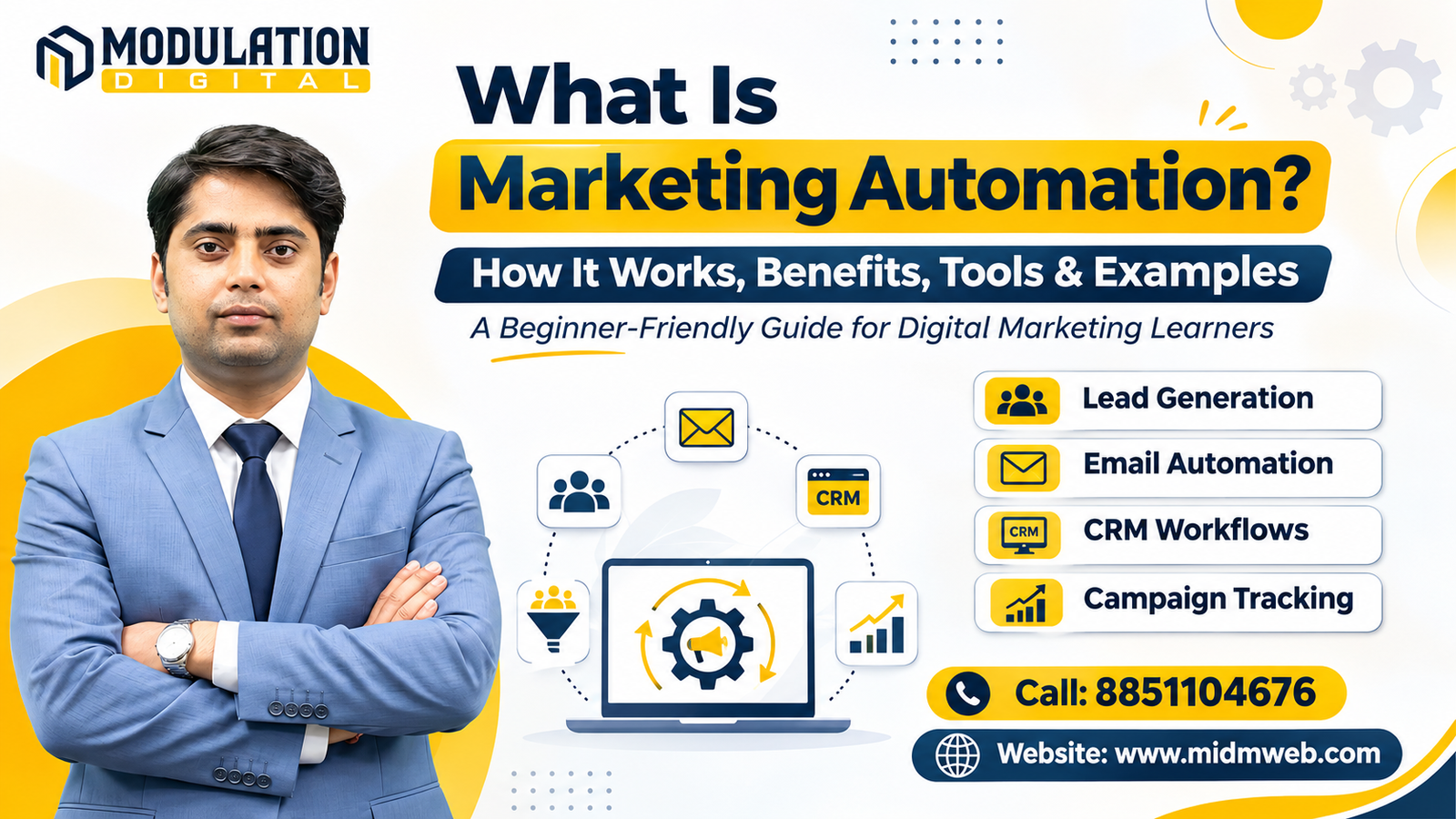
What Is Marketing Automation?
Imagine running a business where every new customer enquiry receives an instant response, potential customers get relevant information automatically, and your marketing team spends less time managing repetitive tasks.
Now imagine completing everything manually. You would need to track hundreds of enquiries, respond to emails, schedule follow-ups, update customer records, and monitor campaign performance every day.
This is where marketing automation changes how businesses manage their digital marketing activities.
Marketing automation is the process of using software and predefined workflows to automate repetitive marketing tasks, manage customer interactions, nurture leads, and measure campaign performance.
Understanding what is marketing automation helps businesses, entrepreneurs, and aspiring marketers discover how technology can improve efficiency while maintaining relevant customer communication.
For students exploring the Best Digital Marketing Institute in Delhi, understanding marketing automation alongside SEO, paid advertising, content marketing, social media marketing, and analytics can strengthen their practical digital marketing knowledge.
This guide explains how marketing automation works, its important benefits, different types, popular tools, and how beginners can start learning it.
What Is Marketing Automation in Digital Marketing?
Marketing automation in digital marketing refers to using technology to perform recurring marketing activities based on predefined schedules, customer behavior, or specific conditions.
Instead of manually responding to every enquiry, businesses can configure automated systems to perform actions when certain events occur.
For example, when someone subscribes to a newsletter, the system can automatically send a welcome email.
If the subscriber later downloads a guide, the system may deliver educational resources relevant to that topic, provided the subscriber has agreed to receive such communication.
This helps businesses maintain consistent interactions without manually completing every activity.
However, marketing automation is not simply about sending promotional messages.
Its main purpose is to deliver relevant information to the right audience at an appropriate time.
According to Salesforce's marketing automation guide, automation supports activities such as campaign management, lead nurturing, and customer communication through automated workflows.
Businesses should focus on creating useful customer experiences rather than automating unnecessary communication.
How Does Marketing Automation Work Step by Step?
Marketing automation works by connecting customer actions with triggers, conditions, automated responses, and performance tracking.
The process usually starts when someone completes an action, such as submitting a website form, subscribing to a newsletter, or registering for an event.
A marketing automation system identifies this action and activates a predefined workflow.
Five Important Steps in Marketing Automation
Step 1: Identify the Trigger
A trigger starts an automated process. Examples include website enquiries, email subscriptions, and event registrations.
Step 2: Capture Relevant Customer Information
The system records necessary information, such as a customer's email address and stated interests, when collected appropriately.
Step 3: Apply Workflow Conditions
Conditions determine what happens next. For example, someone interested in SEO training may receive different information from someone interested in website development.
Step 4: Execute Automated Actions
The system performs a configured task, such as sending an email, updating customer records, or notifying a team member.
Step 5: Monitor Campaign Performance
Marketers check whether the workflow operates correctly and contributes to its intended objectives.
Example of a Marketing Automation Workflow
Website Visit → Enquiry Form → CRM Update → Welcome Email → Relevant Follow-Up → Conversion Tracking
This demonstrates how to use marketing automation for lead generation.
An effective workflow should also include appropriate consent management, error handling, and safeguards against repetitive communication.
What Are the Benefits of Marketing Automation for Businesses?
The major benefits of marketing automation include saving time, improving lead management, delivering consistent communication, and tracking marketing performance.
Businesses often spend significant time completing repetitive marketing tasks that suitable technology can handle.
For example, an education company may receive enquiries through its website, social media channels, and advertising campaigns.
Without an organized system, important enquiries may receive delayed responses or get overlooked.
Automation can help organize leads, record relevant information, and notify the appropriate team members.
Benefits of Marketing Automation for Small Businesses
| Benefit | How It Helps | Practical Example |
| Time efficiency | Reduces repetitive work | Automated welcome emails |
| Lead management | Organizes enquiries | CRM lead assignment |
| Personalization | Uses customer preferences | Interest-based follow-ups |
| Customer engagement | Supports timely communication | Educational email sequences |
| Campaign consistency | Follows predefined workflows | Scheduled messages |
| Performance tracking | Measures marketing outcomes | Lead conversion reports |
An important principle is that marketing automation improves the execution of a strategy but cannot replace a well-designed marketing strategy.
Businesses still need suitable audience targeting, useful content, and relevant offers.
What Are the Different Types of Marketing Automation?
Common types of marketing automation include email automation, lead nurturing, CRM automation, social media scheduling, customer segmentation, and customer lifecycle campaigns.
Each type supports a different activity within digital marketing.
Email Marketing Automation: Sends relevant messages based on subscriptions, customer actions, or scheduled campaigns.
Lead Nurturing Automation: Provides educational information to prospective customers at different stages of their decision-making journey.
CRM Automation: Updates customer information, organizes enquiries, and notifies sales teams about important activities.
Social Media Automation: Helps marketers schedule content and manage recurring publishing tasks.
Customer Segmentation Automation: Groups customers according to relevant interests, behaviors, or preferences.
Customer Lifecycle Automation: Supports onboarding, post-purchase communication, renewal reminders, and customer retention activities.
For example, an online store can use automated marketing campaigns to send purchase confirmations and relevant post-purchase guidance.
However, businesses should select automation methods according to their actual requirements rather than implementing every available feature.
How Can Marketing Automation Improve Lead Generation?
Marketing automation for lead generation helps businesses capture enquiries, organize prospective customer information, and provide relevant follow-up communication.
Consider someone visiting a website to enquire about a digital marketing course.
The visitor completes a form requesting information about SEO training.
The automation system can record the enquiry and send an acknowledgement.
The admissions team can then receive a notification containing the necessary contact details.
If the visitor has agreed to receive additional messages, the system may provide relevant course information or a counselling invitation.
This process is known as lead nurturing, which involves developing relationships with potential customers through useful communication.
Lead Generation Automation Process
Lead Capture → Lead Segmentation → Personalized Follow-Up → Sales Interaction → Conversion Analysis
Businesses should recognize that not every enquiry represents immediate purchase intent.
Successful lead nurturing depends on understanding customer requirements and delivering relevant information rather than repeatedly sending promotional messages.
Which Marketing Automation Tools Are Best for Beginners?
Popular marketing automation tools for beginners include HubSpot, Mailchimp, ActiveCampaign, Zoho Marketing Automation, and Salesforce marketing solutions.
These platforms offer different automation features, integrations, and campaign management capabilities.
HubSpot provides CRM-connected marketing automation, lead management, and campaign workflows.
Mailchimp supports email marketing and automated customer communication.
ActiveCampaign offers email automation, audience segmentation, and customer journey management.
Zoho Marketing Automation provides marketing workflows that can connect with other business applications.
Salesforce offers marketing technology for businesses managing customer relationships and multichannel campaigns.
Students learning digital marketing automation tools should compare platforms based on ease of use, features, integration capabilities, pricing, and privacy requirements.
For beginners, creating a basic welcome email workflow is a useful starting point.
Understanding triggers, conditions, actions, and reporting is more valuable than memorizing software features.
What Is the Difference Between Email Marketing and Marketing Automation?
Email marketing focuses on communicating through email, while marketing automation can connect emails with CRM systems, website interactions, lead management, and other marketing activities.
Email marketing commonly includes newsletters, promotional campaigns, product announcements, and educational content.
Marketing automation can include these emails while coordinating communication with broader customer journeys.
For example, a business might send the same monthly newsletter to its subscribers.
An automated system could send different educational messages based on the subjects subscribers selected during registration.
This helps businesses deliver information that is more relevant to individual interests.
However, personalized marketing automation should respect customer privacy, communication preferences, and applicable data protection requirements.
The difference matters because businesses should choose technology based on actual marketing needs rather than software complexity.
How Is Artificial Intelligence Improving Marketing Automation?
AI-powered marketing automation uses artificial intelligence to assist with audience analysis, content preparation, campaign recommendations, and predictive marketing activities.
Traditional automation usually follows predefined rules.
For example, a welcome email is sent when a subscriber completes a registration form.
AI-supported systems may analyze campaign data to identify patterns and recommend adjustments to messaging or targeting.
Generative AI can help marketers prepare email subject lines, campaign messages, and content variations.
However, AI-generated content may include inaccurate information or unsuitable promotional claims.
Human review is essential for maintaining factual accuracy, brand consistency, customer relevance, and responsible data handling.
Businesses should also evaluate how customer information is processed by AI-powered systems.
AI is most useful when combined with a clear strategy, appropriate safeguards, and ongoing performance evaluation.
How Can Beginners Learn Marketing Automation Step by Step?
Beginners can learn marketing automation by studying digital marketing fundamentals, understanding customer journeys, exploring CRM systems, and practicing workflow development.
Start by learning how businesses attract visitors through SEO, content marketing, social media marketing, and paid advertising.
Next, understand how customer enquiries are collected and managed.
Explore CRM platforms to learn how customer information supports marketing and sales activities.
Once these fundamentals are clear, develop a simple automation workflow.
For example, create a test enquiry form and configure an automated acknowledgement email.
Then verify whether the enquiry information is recorded correctly and the email reaches the intended recipient.
Finally, evaluate the workflow using relevant performance indicators, including engagement, qualified leads, and conversions.
This provides a practical foundation for how to learn marketing automation step by step.
Beginners should remember that marketing automation skills develop through consistent experimentation, troubleshooting, and campaign evaluation rather than passive learning alone.
Why Should Digital Marketing Students Understand Marketing Automation at Modulation Digital?
Students exploring the Best Digital Marketing Institute in Delhi can consider Modulation Digital when comparing digital marketing training programs and practical learning opportunities.
Marketing automation connects several important digital marketing skills, including customer journey planning, content strategy, analytics, lead generation, and campaign optimization.
Students benefit from understanding how these activities work together rather than studying marketing channels independently.
For example, a practical marketing assignment could involve planning a lead generation campaign, designing an automated follow-up process, and analyzing the resulting enquiries.
Such activities help learners connect technical marketing concepts with realistic business requirements.
Modulation Digital is located in Laxmi Nagar, Delhi, near Laxmi Nagar Metro Station, Gate No. 5.
Students researching a digital marketing course in Delhi with practical training can explore its available training programs.
Before enrolling, prospective learners should confirm the current course syllabus, trainer experience, project opportunities, and whether marketing automation tools are included in the selected program.
Modulation Digital Contact Information
Institute Name: Modulation Digital
Address: D-126, Gali No. 6, Near Laxmi Nagar Metro Station, Gate No. 5, Laxmi Nagar, Delhi – 110092
Contact Number: +91 8851104676
Website: https://www.midmweb.com/
FAQs
1. What Is Marketing Automation in Simple Words?
Marketing automation means using software to manage repetitive marketing tasks such as sending emails, organizing enquiries, scheduling communication, and managing customer follow-ups. It helps businesses maintain consistent communication while reducing manual work.
2. How Does Marketing Automation Work for Small Businesses?
Small businesses can create automated workflows that respond to customer actions. These workflows may send confirmation messages, update CRM information, notify employees, and deliver relevant follow-up communication.
3. What Are the Benefits of Marketing Automation for Small Businesses?
The benefits of marketing automation for small businesses include better task efficiency, organized customer information, timely communication, and more consistent campaign management.
4. Which Marketing Automation Tools Should Beginners Learn?
Beginners can explore HubSpot, Mailchimp, ActiveCampaign, and Zoho to understand automated workflows, email campaigns, audience segmentation, and customer relationship management.
5. Is Marketing Automation Important for Digital Marketing Careers?
Marketing automation is valuable for professionals working in email marketing, CRM management, customer lifecycle marketing, lead generation, and marketing operations. Its importance depends on the job role and employer requirements.
6. What Is the Difference Between CRM and Marketing Automation?
A CRM system organizes customer relationships and interaction records. Marketing automation software coordinates marketing activities through workflows, customer actions, and campaign information. Some platforms combine both capabilities.
7. Which Is the Best Digital Marketing Institute in Delhi for Learning Marketing Automation?
Students comparing the Best Digital Marketing Institute in Delhi can explore Modulation Digital in Laxmi Nagar. Before enrolling, review the current course syllabus, faculty experience, practical assignments, and availability of marketing automation modules.
8. How Does AI Help in Marketing Automation?
AI can assist with audience segmentation, content preparation, predictive analysis, and campaign recommendations. Marketers should verify AI-generated information, evaluate results, and maintain appropriate privacy safeguards.
Conclusion
Understanding what is marketing automation helps marketers recognize how technology can simplify recurring activities, organize customer communication, and support effective campaign management.
Marketing automation connects important digital marketing processes, including lead generation, customer segmentation, email marketing, CRM management, and conversion tracking.
However, successful automation requires a clear strategy, accurate customer data, useful communication, and continuous performance monitoring.
Beginners interested in digital marketing careers can start with basic workflow creation and gradually explore advanced marketing automation platforms.